
Find Loads for Your Truck — Across South Africa and SADC
Finding a load is not the hard part. Knowing who you are dealing with is. Free load coordination across South African and SADC corridors — local and cross-border, one exchange, and every deal goes on the record for both sides.

New to Kweli? Start on your side of the load
I have a truck
Getting started as a transporter →
Add the truck and the corridors it runs, and loads start reaching you.
I have cargo
Getting started as a shipper →
Post the load, then choose from the operators who apply.
Every account can do both — the choice above only sets what you see first.
WhatsApp-integrated, with email, and a web app you keep on your phone — no app store. A load list stops when two numbers are swapped; Kweli carries the job past that and keeps the record of how it went. Free on both sides. Getting started on Kweli Load Exchange — what you are asked for, and why.
Logistics Today: Noise, Noise, Noise
- Multiple Facebook & WhatsApp load threads with conflicting info
- Lots of messages about cross-border loads, little movement
- Wrong trucks getting matched
- Deals that don’t complete
Loads ranked by your truck type and the lanes your truck runs · Browser access · Free
Those lanes are the SADC transport corridors we hold measured road distances for — Johannesburg to Harare through Beitbridge, Durban to Lusaka through Chirundu, and the port runs to Beira and Nacala.
How Load Coordination Works for Truckers & Shippers
- Find loads on key SADC routes
- Match to suitable truck type
- Agree on Kweli LX
- Progress visibly
Each of those steps asks you for something, and each one has a reason. Getting started on Kweli walks through them in order — what you enter, why it is asked, and what happens after.

Kweli Load Exchange
One exchange for operators, shippers and brokers. Local runs and cross-border corridors, on the same board.
- See loads on the corridors your truck runs
- Post a load and reach operators who can actually carry it
- Every deal recorded, for both sides

Kweli Driver Registry
One Driver Profile That Travels With Them.
The Kweli Driver Registry lets a driver keep one profile — licences, experience and completed trips — that a transport operator can search when he needs someone.
Every driver profile includes operational details, route preferences, and activity signals — helping you match loads faster and with greater confidence.
- Driver identity on record
- Route and capacity visibility
- Faster matching with operators who are actually on the road
- Built for owner-drivers and fleets

Kweli Pulse — SADC Logistics Community Forum
The Freight Network Talking Back
Kweli connects drivers with real loads — and backs it with a live community that keeps information flowing.
This means better decisions, faster deals, and fewer surprises on the road.
- Real-time discussions from the field
- Market signals beyond load boards
- Feedback and ratings that come from completed deals
- Community-driven trust
Get Started
If you have not used Kweli before, start here — the transporter’s three steps, the shipper’s three, and what each one is for.


Why Kweli Exists
Southern African logistics already runs on WhatsApp — because it is accessible, familiar, and fast. But over time, that same informality has created noise — especially for cross-border loads, confusion, and risk.
Kweli was built to add the one thing a group chat cannot keep — memory — alongside structure and corridor context — without turning logistics into a rigid or exclusionary system.
Kweli does not try to replace existing groups, brokers, or relationships. It does not promise guarantees, verification, or protection.
Instead, it focuses on one thing only: making behaviour, execution, and outcomes visible over time — within the conversations that already exist. How to know who you are dealing with before you load sets out what is shown to you, and what we refuse to claim.
- The load exchange is free to use
- It runs in your browser — nothing to download from an app store
- Trust is earned through execution, not claims
- Reputation is contextual — by role, corridor, and time
- No subscriptions, commissions, or pay-to-rank mechanics
Kweli exists to bring discipline without gatekeeping, and trust without promises, to local and cross-border logistics across SADC.
Who is Kweli For?
Kweli is built for participants who understand that logistics is not won by noise, speed, or claims — but by follow-through, consistency, and execution. It does not reward visibility or volume on day one. It rewards behaviour over time.
Brokers and Intermediaries
Kweli does not exclude brokers. But it does make roles explicit.
Performance as a broker is assessed separately from performance as an operator or shipper. Volume alone does not confer trust, and trust does not transfer automatically between roles.
This ensures that:
- Effective intermediaries can demonstrate value through execution
- Poor behaviour cannot be hidden behind role switching
- Influence follows outcomes, not position
Kweli recognises the role brokers play — without allowing them to dominate the system.
Shippers and Load Posters
Kweli is built for shippers who want better outcomes without surrendering control. It does not force commitments, contracts, or exclusivity. Instead, it provides context.
Over time, patterns emerge:
- Which operators deliver as agreed
- Which corridors behave predictably
- Which arrangements consistently break down
This allows decisions to be made with more clarity — without relying solely on claims, introductions, or urgency.
Kweli reduces uncertainty without centralising power.
Transport Operators and Fleet Owners
Kweli is designed for operators who do the work — whether they run one truck or many. Performance is not measured in general terms or global rankings. It is assessed within corridors, by role, and over time.
This means:
- A reliable operator on a specific route is recognised as such
- Consistency matters more than scale
- Quiet operators are not drowned out by louder ones
- Reputation cannot be reset simply by moving to a new group
Kweli makes dependable execution visible — even when it is not advertised.
Kweli is not built for those seeking instant leverage.
It is built for participants who are willing to:
- Show up consistently
- Honour commitments
- Allow their actions to speak over time
In Kweli, effort compounds, truth accumulates, and trust emerges naturally.
The Kweli Knowledge Hubs
Kweli runs on two things: corridors, and memory. A corridor is the lane a truck actually runs — hub to hub, on the real road, with the passes, borders and weighbridges that sit on it. The memory is the record of what happened on that lane: who collected when they said, who paid when they said, and what the load actually was.
Every guide below is built from those two things and from our own operational data, not from general industry commentary. Where we do not hold the data, the page says so rather than estimating.

- Trucks and what they carry — a truck is three separate decisions made as one: the body, the rig and the axles. 34 trailer types, seven configurations, and what horsepower actually buys you.
- Abnormal, bulk and special loads — where “abnormal” begins, and how escorts, flags and speed restrictions are calculated from your dimension class and the category of road you are using.
- Border posts — 24 crossings with their operating hours and one-stop status. Only seven run 24 hours and nine close at 18:00, which costs more nights than the queues do.
- Rates and running costs — what a truck actually costs to run per kilometre, and the arithmetic behind a rate rather than a number to copy.
- The trucking business — what decides which loads reach your truck first, and why nothing about your truck locks you out of the rest. Plus what the board actually pays and when.
- Truck drivers: pay and licences — the bargaining council minimum from 1 March 2026, and why one Code 14 licence spans three different pay grades.
- Countries we cover — 14 you can route a load to, 17 with named freight hubs, 21 in the place index. A place you can spell is not a lane you can run, and the page says which is which.
- Find trucks for your load — for cargo owners: the six fields that decide whether an operator takes your load, and which two are missing from four in ten posts.
- Roads and safety — the passes and weighbridges on each freight lane, placed by the kilometre they sit at, and why the flat run before a descent is the dangerous part.
Nine hubs over 150 guides, all free to read and none of it behind a signup.
News and Articles
-
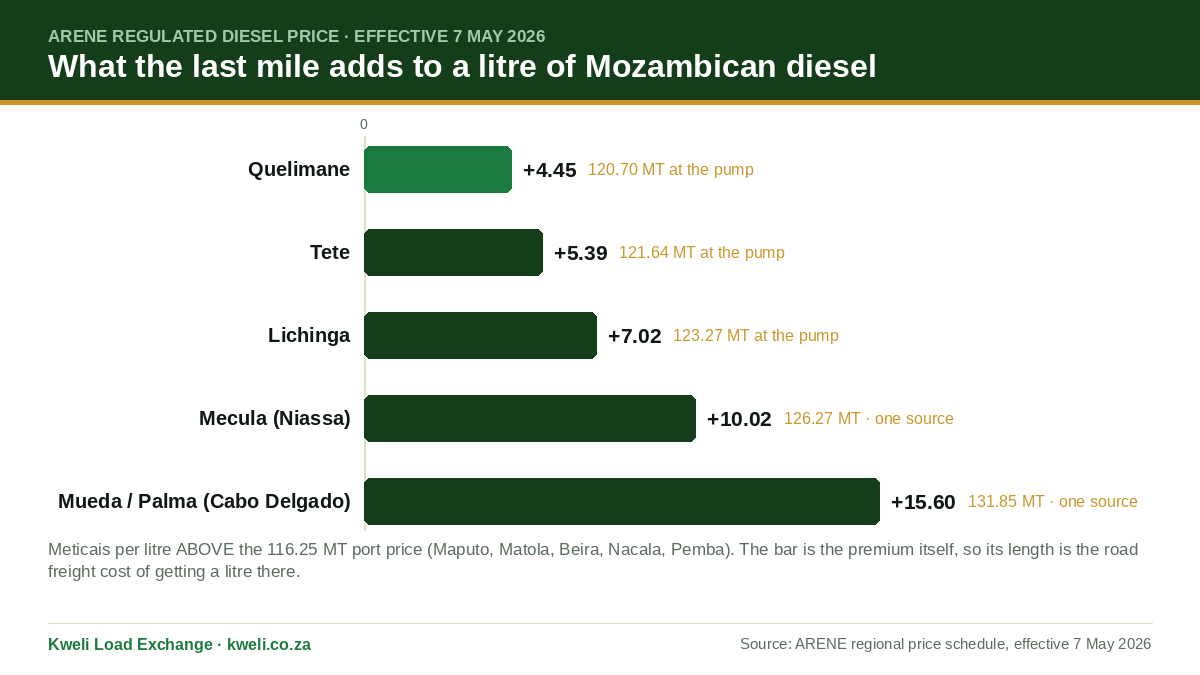
Mozambique Diesel Price 2026: 116.25 MT and Six Regional Prices
Mozambican diesel rose 45.5% in a single step on 7 May 2026 to 116.25 MT a litre at the ports…
-
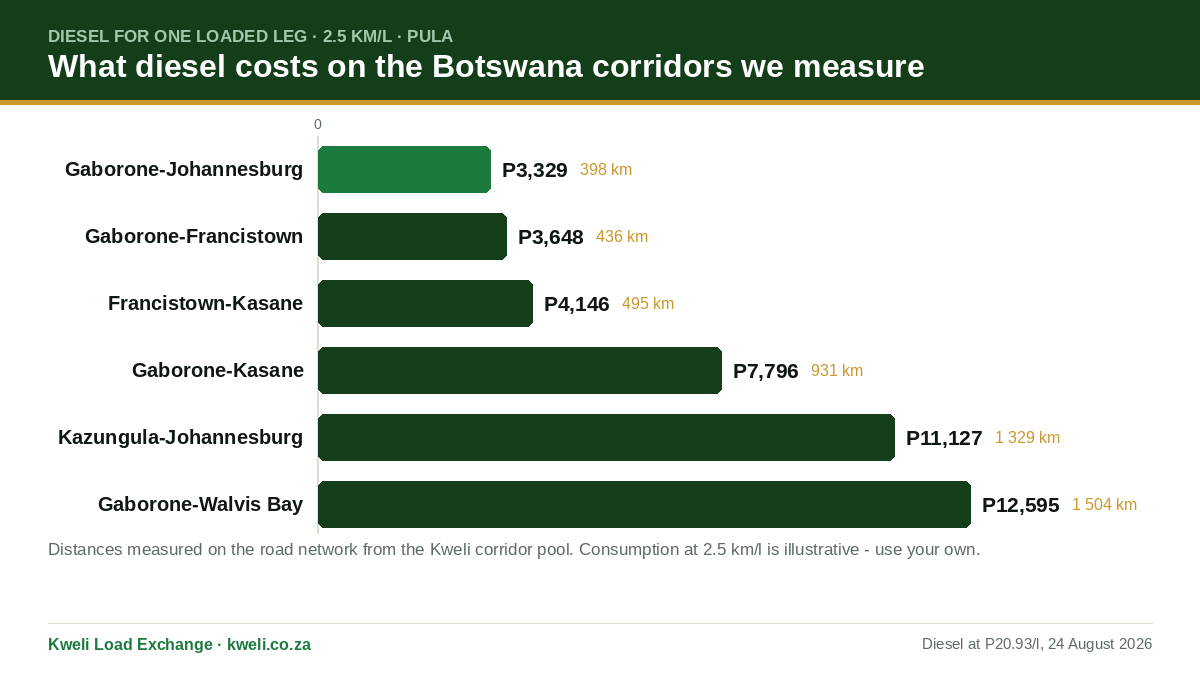
Botswana Diesel Price 2026: the P8.77 Jump and the Levy Suspension
BERA raised diesel by P8.77 a litre in March 2026 and cut it by P4.12 on 7 July, to P20.93.…
-
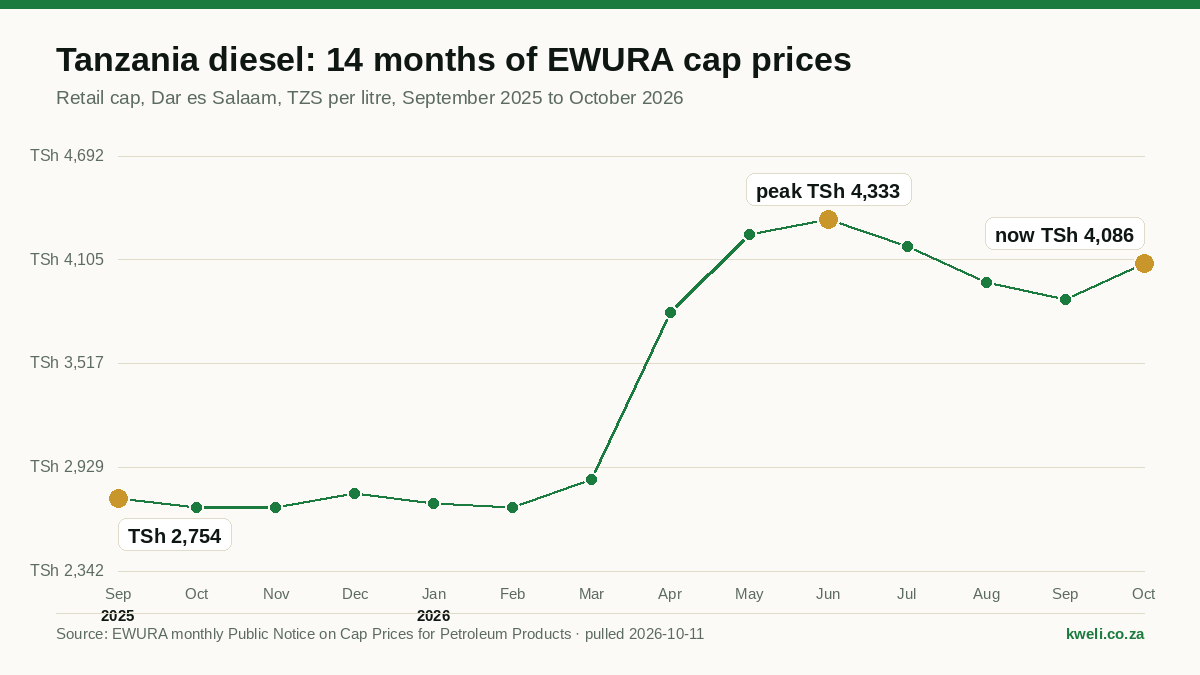
Tanzania Diesel Price October 2026: EWURA Cap TSh 4,086 and the 14-Month Trend
EWURA caps diesel at TSh 4,086 in Dar es Salaam from 7 October 2026, up TSh 209. A 14-month series…
-
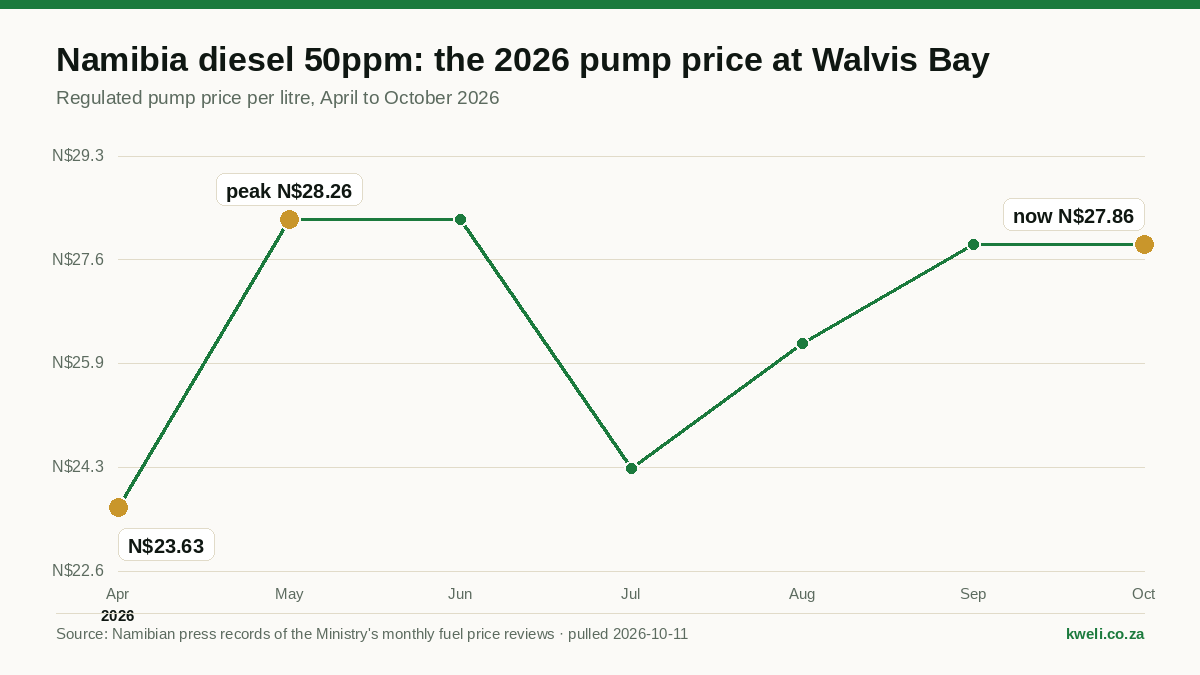
Namibia Diesel Price October 2026: N$27.86 at Walvis Bay
Diesel 50ppm stays at N$27.86 at Walvis Bay from 7 October 2026 while petrol rises N$1.50. Because the Namibia dollar…
-
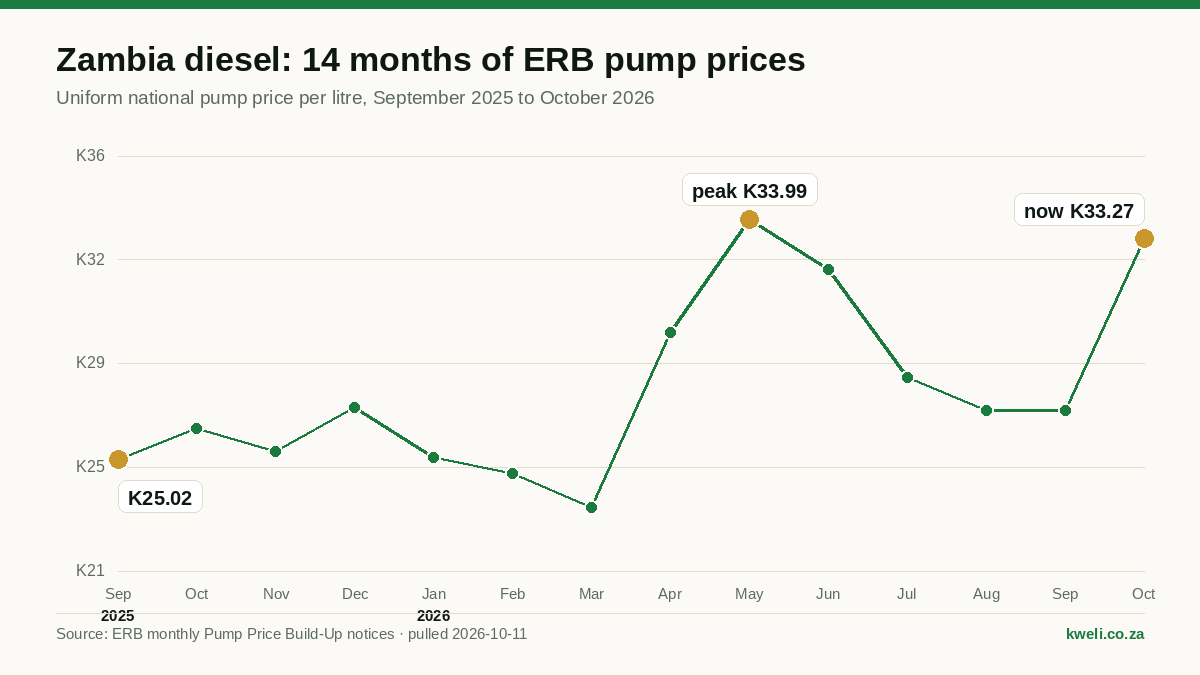
Zambia Diesel Price October 2026: K33.27 and the 14-Month ERB Trend
The ERB raised Zambian diesel K6.41 to K33.27 a litre from 1 October 2026 as six months of fuel tax…
-

Empty Running Is the Real Fuel Cost: R12.78 a Kilometre Becomes R25.56
An empty return leg exactly doubles fuel cost per paid kilometre – the same on a 571 km lane and…


