Kiungo practical reading · Freight brokers, agents, 3PLs and their clients
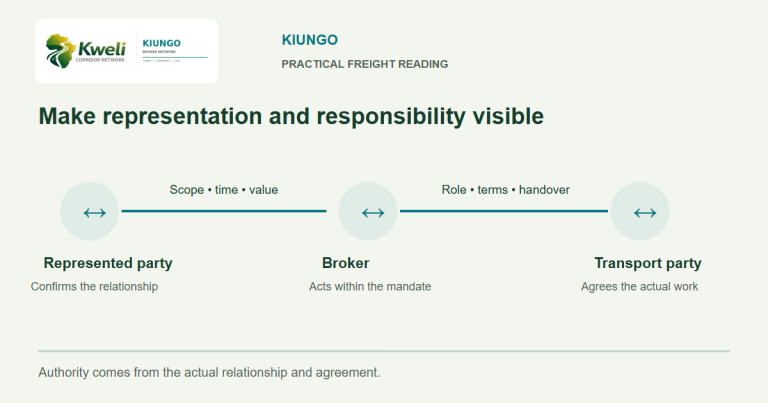
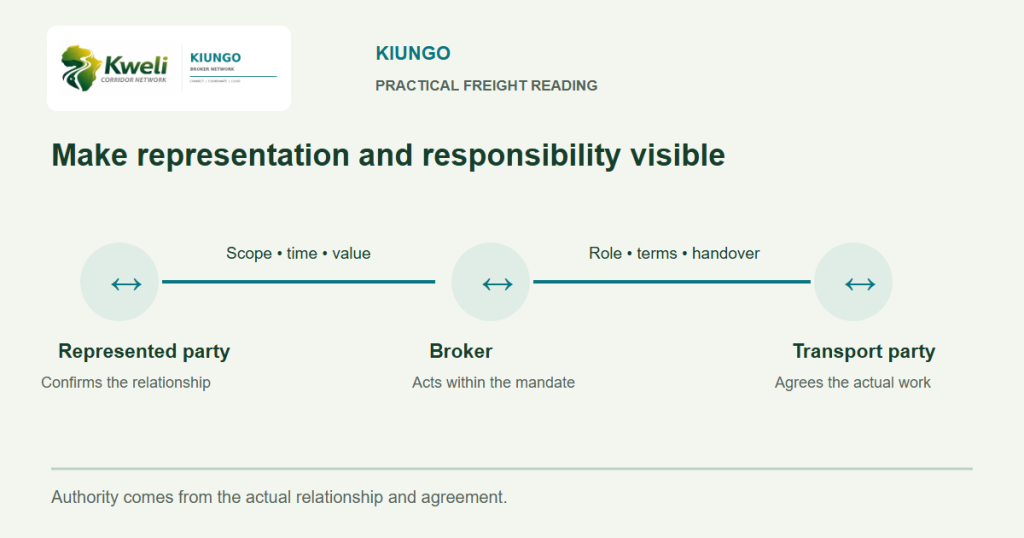
Before a broker acts, the represented party and broker should understand the relationship and the limits of authority. Record who may do what, for which work, for how long and subject to which approvals. A forwarded company logo is not a mandate.
A shipper may ask an intermediary to source possible trucks without authorising them to accept a rate. A transporter may allow a broker to advertise capacity without giving permission to commit the vehicle. Confusing these arrangements can create two promises where neither principal intended one.
Use a plain-language scope conversation
- Which named business is being represented?
- What tasks may the broker perform?
- Which loads, lanes or equipment are in scope?
- What value limit or approval requirement applies?
- When does authority start and end?
- Who may change the scope or end the relationship?
- How will other parties recognise the disclosed broker role?
Keep representation, the freight agreement and the broker’s own commercial terms distinguishable. This is an operating checklist, not a substitute for a properly reviewed legal agreement or advice about a particular contract.
A limit should change the next action
For illustration, a broker may be allowed to seek quotations but needs the principal’s approval before award. When an acceptable offer arrives, the next action is to obtain that approval. The existence of an online account should not be read as permission to bypass it.
Likewise, a mandate that has expired should prompt reconfirmation. Do not continue relying on an old message because a new opportunity is urgent.
Where Kiungo provides structure
Kweli Kiungo supports registering represented parties, inviting them to confirm the relationship and agreeing mandates with time and value boundaries. It also supports publishing broker-origin stock into LX and committing work to transporters.
The broker is the broker and contracting party with its shipper and transporter; Kweli provides the software. A recorded relationship helps make roles clearer but should not be described as universal legal certification of every action.
Keep the free exchange open and the role visible
Free LX serves specific large-truck B2B loads. Kiungo is the separate paid broker-workflow product. Its current plan and any usage charges are shown in the Hub; those charges are distinct from freight rates and broker remuneration agreed by participants.
Before the next movement, ask the people doing the work to identify who can approve a change. If they cannot answer, the authority arrangement needs attention before dispatch.
Practical questions
Does permission to find a truck automatically permit a broker to award work?
No. The permitted actions and approvals need to be established in the representation arrangement. Sourcing a quotation and committing a load can be different authorities.
Does Kiungo make Kweli the freight broker?
No. The broker remains the broker and contracting party with its shipper and transporter. Kweli supplies the software.
Reviewed 7 November 2026. Examples are illustrative, not customer case studies. Product availability and current terms should be checked through official Kweli or Synesys guidance.