Kiungo practical reading · Freight brokers, agents, 3PLs and their clients
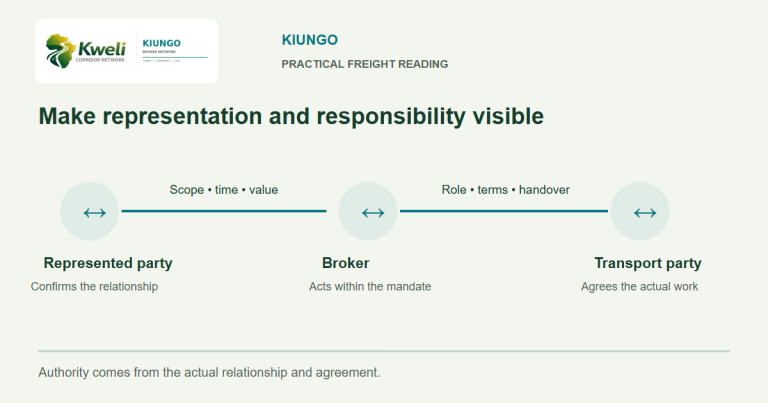
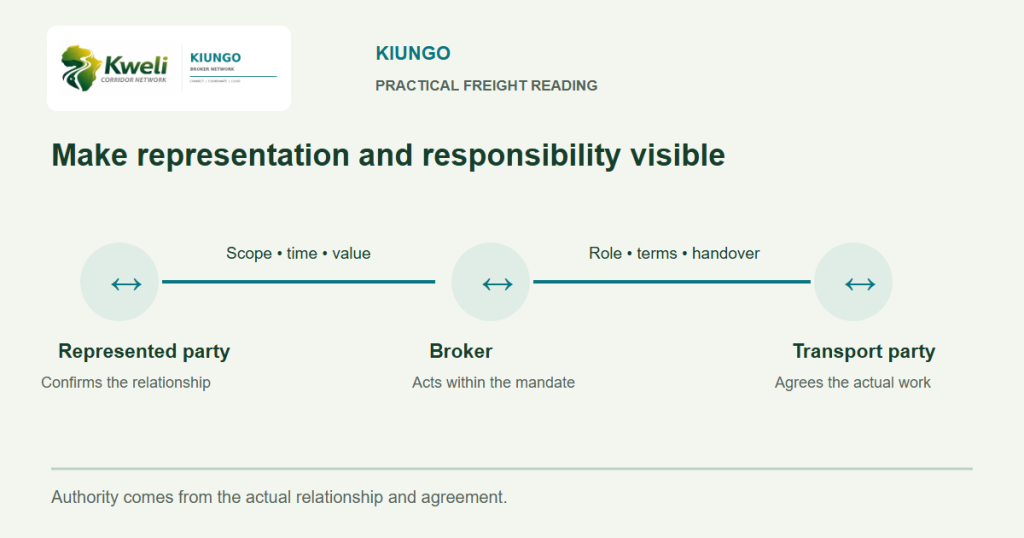
For a broker-origin load, establish the broker’s role, the contracting parties and who is responsible for payment and operating decisions. Broker involvement can be legitimate and useful. The difficulty is undisclosed or unclear responsibility.
A load message can mention a well-known manufacturer while the person offering the work is an intermediary. The truck operator should not infer that the manufacturer is its customer or debtor. Ask who will place the order, receive the invoice and approve a change.
Read the relationship as well as the cargo
- Who posted or offered the load?
- Which party do they represent, and in what capacity?
- Who is entering the agreement with your business?
- Who can confirm site and cargo instructions?
- Who approves waiting, route changes or extra stops?
- Who receives the invoice and what payment terms apply?
Confirm sensitive changes through an appropriate known channel. A new contact claiming to replace the original broker is a reason to check authority, not to redirect cargo or documents immediately.
Use a simple relationship note
In an illustrative movement, the note might read: “Broker B contracts the carrier for the specified job. Collection instructions are confirmed through B with the shipper contact. Rate changes require B’s agreed approval. Invoice goes to the contracting customer identified in the order.” The correct note depends on the real arrangement.
Do not copy this example as a contract. Its purpose is to expose gaps before work begins. If two parties give conflicting instructions, stop treating the issue as a routine dispatch update and seek clarification from the proper decision-makers.
Make broker origin visible on the exchange
Kiungo supports publishing broker stock into LX clearly marked as broker origin, alongside confirmed representation and mandate workflows. That helps participants understand who is acting. The platform does not guarantee cargo authenticity, performance or payment simply because a role is displayed.
Free LX is the open B2B exchange for large cargo trucks. The paid broker tools have separate terms; the transport parties still negotiate their own commercial arrangements.
Keep a complete job brief too
Clear representation does not fill in missing mass, dimensions, collection times or delivery evidence. Check equipment fit and price the full movement with your own cost inputs. A genuine broker relationship can still offer work that is unsuitable for a particular truck.
Practical questions
Is the cargo owner automatically the transporter’s customer on a broker load?
No. Establish the actual contracting parties, invoice recipient and payment responsibility. A cargo owner’s name in a message does not settle that relationship.
Does a broker-origin label guarantee payment?
No. The label explains origin and role. Participants still need to assess the counterparty, authority and agreed commercial terms.
Reviewed 7 November 2026. Examples are illustrative, not customer case studies. Product availability and current terms should be checked through official Kweli or Synesys guidance.