Atlas + Synesys practical reading · Small, emerging and informally organised transport partners
Keep enough operating evidence to understand the complete trip before treating more loads as growth. Revenue tells you what was earned under the agreement; it does not by itself show the cost, contribution or cash available to run the next movement.
A busy truck can hide weak economics when empty travel, waiting and administration are not visible. For a small operator, a consistent modest record is often more useful than a dashboard based on incomplete inputs.
Start with a few checkable facts
- Agreed revenue and its scope.
- Loaded, empty approach and return distance.
- Fuel quantity and actual purchase cost.
- Relevant tolls, site costs and approved extras.
- Waiting and changed instructions.
- Invoice submission and actual payment status.
Define what your operating cost per kilometre contains. If it includes fuel and maintenance, do not add those again as separate full costs. Keep business costs that are not included visible when interpreting the result.
A simple complete-trip example
Assume an illustrative R16 operating CPK, 800 loaded kilometres and 400 empty kilometres. Included distance cost is R19,200 over 1,200 kilometres. Looking only at the loaded distance would show R12,800 and omit R6,400. Other costs not already in the CPK still need consideration.
These values are teaching assumptions, not a benchmark or proposed freight rate. The free Kweli calculators let an operator test its own numbers. Cost estimates help frame a decision; they do not predict a particular customer’s payment or future demand.
Ask what the records reveal
Did the route differ from the quote? Was the return opportunity actually agreed? Is a recurring collection delay affecting the next allocation? Does the business have a payment-timing problem even when the included trip contribution looks positive?
Bring those questions into a review before taking on a larger commitment. This is an operating-record discipline, not a recommendation to borrow, buy a vehicle or make an investment.
How partner enablement can help
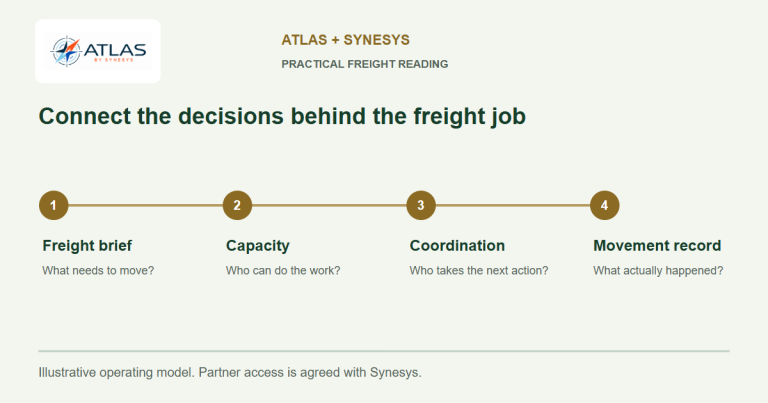
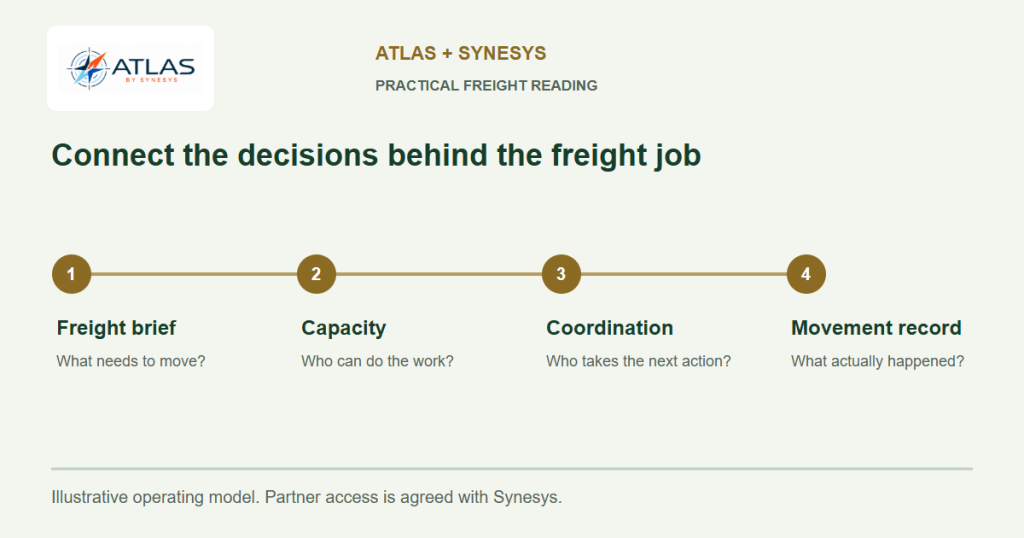
Atlas is the Synesys cargo and freight business management system, supporting a shared context for planning, operations and administration. Trusted partners receive free software access under agreed terms and can use it for their own freight work. Confirm the actual reporting and cost workflow instead of assuming every expense is captured automatically.
IFC’s 2024 digital-opportunities research highlights a gap between access to tools and their productive use. For this operator, productive use means a record that changes a real decision, not a claim that software guarantees profit.
Free LX helps open a freight conversation. Understanding the complete job helps the operator decide which conversations it can responsibly turn into work.
Practical questions
Does higher truck turnover necessarily mean better profit?
No. Review complete costs and the meaning of the result. Also distinguish earned revenue, invoiced amounts and cash actually received.
Does Atlas automatically capture every operating expense?
Do not assume that. Confirm the actual workflow and inputs with Synesys. A useful record still depends on accurate, complete information.
Reviewed 7 November 2026. Examples are illustrative, not customer case studies. Product availability and current terms should be checked through official Kweli or Synesys guidance.