Atlas + Synesys practical reading · Small, emerging and informally organised transport partners
A phone connects people; a working business routine connects the decisions behind a freight job. A small operator may use calls, messaging and photographs every day yet still struggle to find the latest instruction, explain a cost or produce the right delivery record.
This is not a failure of ambition. The owner may also be the driver, dispatcher and administrator. A tool has to justify the time, data and learning it requires. The useful starting point is the problem it removes from that person’s day.
Access and productive use are different
IFC–World Bank research published in 2023, using a survey of microenterprises in seven African countries, identified affordability and skills barriers. It found associations between digital use and performance, not proof that software caused better results.
The study covers several industries, not a representative survey of African trucking. It provides context for asking better questions; it cannot establish how every transporter works. Countries, routes, businesses and access conditions differ.
Look for the broken handover
Consider an illustrative one-truck business. The owner agrees a price by phone, receives a collection change in a message and gets the POD as a photograph. Each tool works, but no single working record connects the final scope, the change and the outcome.
- Which instruction is current?
- Who agreed the change?
- What did the driver actually do?
- Where is the required evidence?
- What must happen before the office can finish the job?
Start by answering those questions for one movement. A job reference, a shared brief and a named next action can be more useful than digitising every document at once.
What an operating system should support
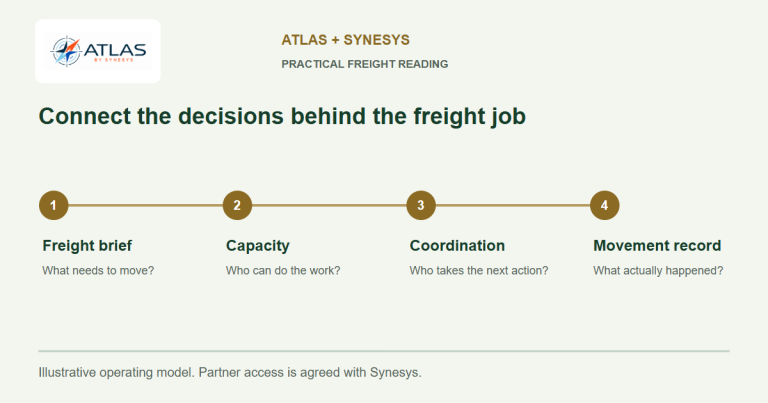
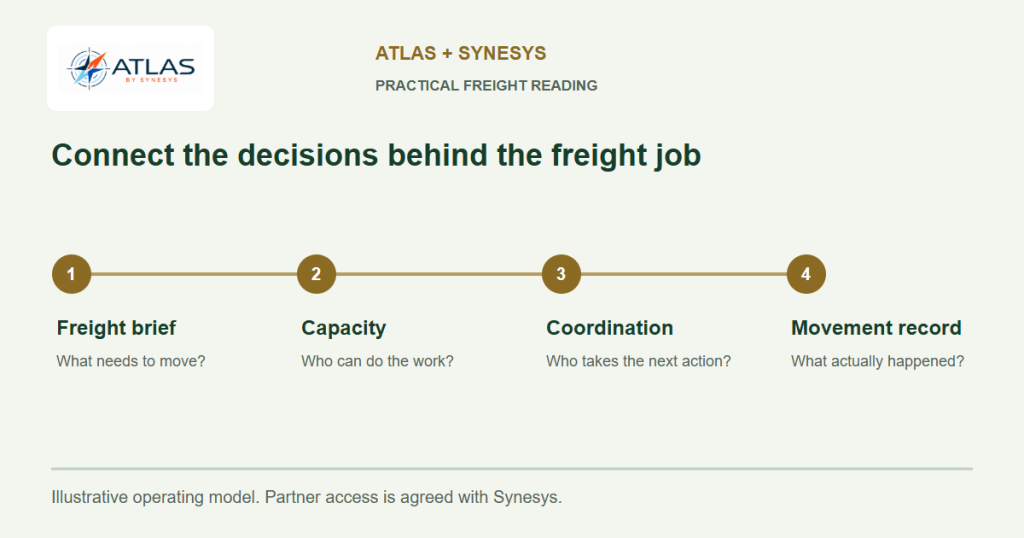
Atlas, powered by Synesys, is a cargo and freight business management system and ERP. Its role is to keep the brief, capacity decisions, handovers and movement record in a shared operating context. Trusted Synesys transport partners receive software access free under their agreed partnership terms, for Synesys work and their own freight business.
The relevant question is whether the operator can complete a real working sequence with support. Free access does not by itself supply connectivity, training, correct inputs or dependable demand. A demonstration should follow an actual type of job and expose the points where help is needed.
Start with a small baseline
For the next few movements, note how often the office searches for instructions, requests the same document or calls again for delivery evidence. Use those observations to choose a first improvement. Measure the same problem after adoption before claiming time saved.
Free Kweli LX can help find specific large-truck B2B work; the free calculators help examine costs. Atlas is a separate Synesys partner business system. Do not assume automatic data transfer or a shared account between them.
Digital enablement should make an honest operator’s work easier to organise and demonstrate. It succeeds when the person can use the record to make the next decision, not merely when the business owns another login.
Practical questions
Does African microenterprise research prove Atlas will improve a transporter’s profit?
No. The cited research provides broader context and reports associations, not an Atlas evaluation or guaranteed causal effect. Operators should assess actual working outcomes.
Is Atlas free for every public visitor?
No. Trusted transport partners working with Synesys receive free software access under agreed partnership terms. The operator’s intended arrangement and onboarding must be discussed with Synesys.
Reviewed 7 November 2026. Examples are illustrative, not customer case studies. Product availability and current terms should be checked through official Kweli or Synesys guidance.