Port guides · Corridors and major road lanes
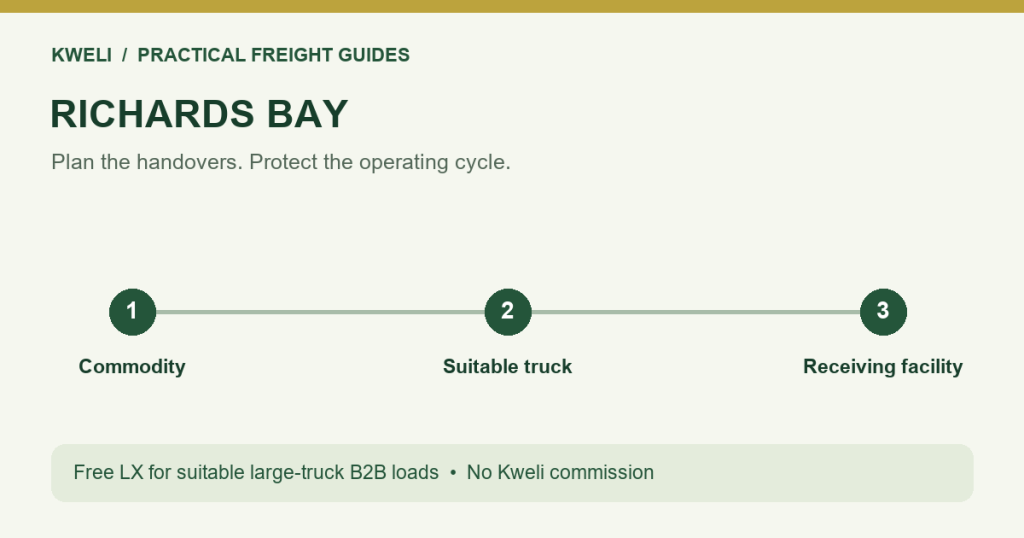
For Richards Bay work, start with the commodity and the receiving facility, then decide whether the truck fits. A port destination does not mean that every bulk load can use the same trailer, gate or unloading method.
Do not treat all Richards Bay cargo as one operation
Transnet Port Terminals describes bulk and break-bulk operations at Richards Bay. Its published material explains that cargo can arrive by road or rail and use different storage and handling systems. Those facts do not establish a road-haulage opportunity for every shipment. Identify the operator and facility named in the actual instruction.
For a small operator, the expensive mistake is accepting a commodity label without the working detail. “Minerals to Richards Bay” leaves unanswered questions about grade, containment, contamination, loading method and the receiving slot. Get those answers before you commit the truck or price.
Build a load brief around the material
- Exact cargo description and any declared handling or safety requirements.
- Collection site, loading equipment and the party confirming quantity.
- Vehicle and trailer configuration acceptable at both ends.
- Receiving stockpile, warehouse or terminal reference and authorised contact.
- Weighing, sampling or other acceptance evidence required by the agreement.
- Instructions if the cargo or paperwork is rejected.
Do not infer hazardous-goods classification from a casual description. Obtain the appropriate cargo information from the responsible party and check the applicable requirements before accepting it. A general freight guide cannot approve a particular vehicle or material.
Make quantity and waiting visible
Record the load identifier consistently on collection documents, weighbridge records and delivery evidence. Where quantities differ, keep the actual records and ask the responsible parties to resolve the discrepancy. Do not silently replace a collection quantity with a delivery figure.
An illustrative one-truck business may complete the road leg on time but spend longer than planned awaiting acceptance. Its next collection is then at risk. Record arrival, the reason given for the hold, the responsible contact and the next review time. Payment for waiting depends on the agreed terms, not merely on the existence of a timestamp.
Protect the margin across the whole cycle
Include approach distance, loading, unloading, cleaning where relevant, driver time and the next position in the quote. A specialised trailer may have fewer suitable return opportunities. Compare the confirmed movement with a conservative empty-return scenario using the calculators; do not make an unawarded backload pay for the outbound trip on paper.
Use free LX for specific suitable large-truck opportunities and describe equipment honestly. Keep the next available time current after delays. KITE can support the agreed job’s dispatch and evidence, while Atlas is a separate Synesys business system with free software access for trusted partners under agreed terms. Neither creates a cargo contract or guarantees demand.
Practical questions
Does a Richards Bay port load always need the same trailer?
No. The commodity, collection method and named receiving facility determine the equipment and handling checks. Confirm both ends before agreeing the work.
How should a small operator price a port bulk trip?
Use its own complete-cycle costs, including the approach, loading and unloading exposure, relevant cleaning and return position. Keep unconfirmed backloads separate from contracted revenue.
Official sources and current checks
Reviewed 7 November 2026. General planning guidance, not live terminal status, approved routing, customs advice or a tariff. Confirm current instructions for the actual consignment with the responsible parties.