Port guides · Corridors and major road lanes
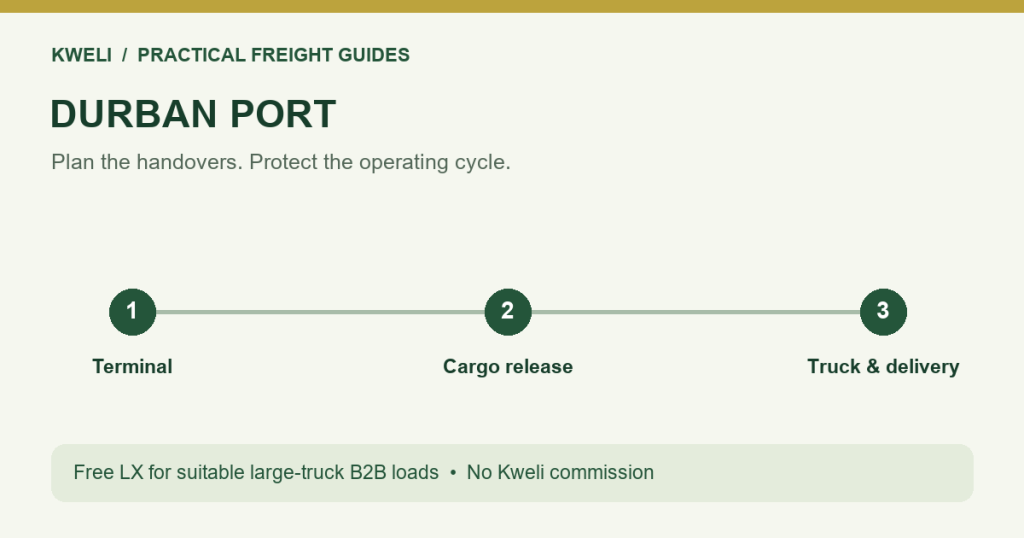
A Durban port load needs more than a container number and a truck. Before accepting the movement, establish the exact terminal or depot, who can release the cargo, the collection arrangement and where the equipment goes after delivery. The port name alone is not a dispatch instruction.
Which Durban facility does the job actually use?
Transnet Port Terminals publishes separate operational updates for Durban Container Terminal Pier 1, Pier 2 and other Durban facilities. Read the update for the facility in the job brief. A container collection, a break-bulk movement and a depot collection can require different equipment and handovers.
Ask for the actual collection point in writing. If an agent says “Durban”, clarify whether the truck goes into a terminal, a container depot or an inland warehouse. Include the destination address and any intermediate unpacking stop before comparing prices.
Separate cargo release from the truck appointment
A ship having arrived does not establish that its cargo can be collected. Ask the responsible shipping or clearing contact to confirm the relevant release, outstanding holds and collection reference. Separately confirm the current truck access or booking procedure with the actual terminal. Do not assume that one reference replaces the other.
- Container identification, size, declared mass and any special handling.
- Correct trailer, legal loading arrangement and available driver.
- Authorised collection reference and named contact for a rejected release.
- Delivery booking and the consignee’s unloading capability.
- For container work, empty-return location, acceptance conditions and who pays additional moves.
Cost the complete Gauteng–Durban cycle
For a Johannesburg operator, the N3 line-haul is only part of the working cycle. Include the empty approach, local port or depot travel, waiting exposure, delivery and repositioning. Use your own fuel consumption, driver costs and expected utilisation in the free calculators. Set out which changes need approval rather than relying on a verbal “all in”.
In an illustrative job, the truck delivers an import inland but the empty container must return to a nominated depot. That obligation affects its next availability. Advertising a return load before resolving it can create two commitments for one truck.
Find suitable port work without chasing every listing
Describe the real truck, trailer, area and availability on free Kweli LX, then assess each large-truck B2B opportunity against the actual movement. For shippers, a precise terminal and equipment brief helps suitable transporters respond. LX charges no Kweli commission on its deals; rates, release authority and payment terms remain between the parties.
After agreement, KITE can help keep dispatch, active-job progress, exceptions and delivery evidence together. Its optional paid terms are separate from free LX. Keep terminal communications and actual timestamps with the job so the next quote reflects what the truck really did.
Practical questions
Can I collect a Durban container as soon as the vessel arrives?
Not necessarily. Confirm cargo release, any holds and the current collection or truck-booking arrangement with the responsible parties before dispatch.
Where can I look for Durban port loads for a large truck?
Free Kweli LX supports suitable large-truck B2B load opportunities. Check the terminal, equipment, complete-trip costs and contracting party; no listing guarantees work or payment.
Official sources and current checks
Reviewed 7 November 2026. General planning guidance, not live terminal status, approved routing, customs advice or a tariff. Confirm current instructions for the actual consignment with the responsible parties.