Port guides · Corridors and major road lanes
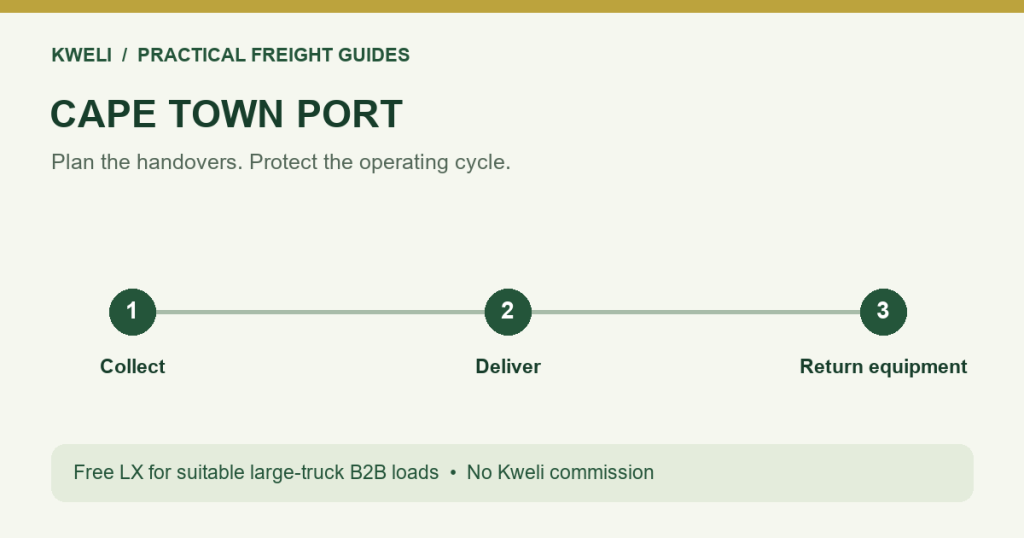
Plan a Cape Town port movement through to its final handover, including any empty-container return. The collection leg, consignee’s unloading arrangements and the truck’s next availability belong in the same brief.
Confirm the terminal and the cargo state
Transnet Port Terminals publishes separate Cape Town container and combi-terminal updates. Use the source relevant to the named facility rather than assuming a general port notice answers every collection question. Vessel schedules and terminal conditions can change; an old screenshot is not a current truck instruction.
Ask whether the work starts at the terminal, an off-port depot or a warehouse. Establish who confirms release, who supplies the collection reference and who authorises changes. A transport quote should identify the actual start and end points, not just “Cape Town harbour”.
Match equipment to the complete job
Confirm container identification, size, declared mass, trailer suitability and the consignee’s means of unloading. If the cargo needs temperature control, obtain the responsible party’s written requirements and clarify which party supplies the necessary equipment and monitoring. A refrigeration assumption made during quoting can become a costly failure at delivery.
- Collection authorisation and current access or booking instructions.
- Receiving appointment, site access and unloading responsibility.
- Special cargo, seal or condition-recording instructions.
- Empty-return depot and the party resolving refusal or a changed depot.
- Named contacts for release, delivery and commercial approvals.
Local work and long-haul work need different cost views
A local container trip may spend more of the working day in handovers than on the road. A Cape Town–Gauteng movement also ties up the truck across a longer cycle. In both cases, price the actual work: approach, collection, delivery, waiting exposure, extra stops and repositioning. Use your own inputs in the free cost-per-kilometre and trip tools.
Consider an illustrative carrier delivering a container inland. If the empty must return to a particular depot, its next load must fit that obligation. Confirm the return instruction before advertising the vehicle as freely available for a different route.
Turn a port enquiry into a clear freight agreement
Shippers can make a large-truck B2B load easier to assess by stating the facility, equipment, cargo and collection readiness on free LX. Transporters should qualify the contracting party and terms as well as the route. LX remains free, with no Kweli commission on LX deals; it does not guarantee release, awards or payment.
Keep actual collection, exception and delivery records with the movement. For recurring port work, review where estimates differed from the real cycle before accepting the next rate. Optional KITE execution tools can support that record; the free exchange remains available independently.
Practical questions
Should the Cape Town port quote include the empty-container return?
Clarify it explicitly. State the required return depot, responsibility, additional moves and applicable terms so the price and next truck availability reflect the complete job.
Is a vessel arrival a confirmed collection appointment?
No. Check the relevant cargo release and current terminal or depot access arrangements separately.
Official sources and current checks
Reviewed 7 November 2026. General planning guidance, not live terminal status, approved routing, customs advice or a tariff. Confirm current instructions for the actual consignment with the responsible parties.