Endesha practical reading · Shippers and logistics teams managing repeat movements
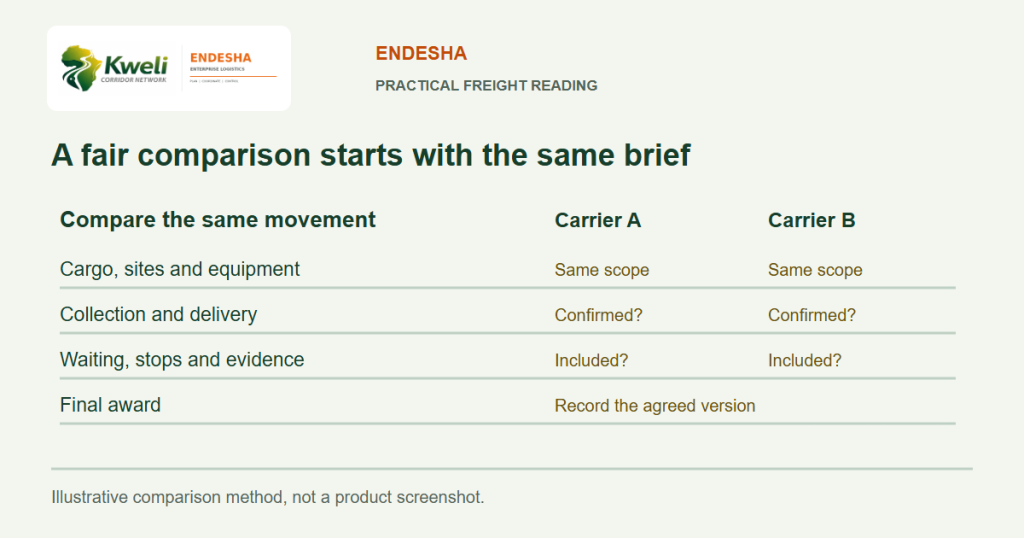
Compare freight quotes only after checking that they cover the same movement and responsibilities. A lower price may exclude waiting, tolls, extra stops or a required service. An equivalent comparison makes those differences visible before an award.
Imagine two illustrative responses to a single load: R18,000 and R19,500. The first assumes immediate loading and one delivery; the second includes an agreed additional stop and a waiting allowance. Choosing by the headline alone can leave the shipper buying a different scope from the one intended.
Use a short comparison sheet
- Same cargo, quantity and sites?
- Suitable vehicle and loading arrangement confirmed?
- Same collection and delivery requirements?
- Same treatment of waiting, stops, tolls and changes?
- Required evidence and invoice process understood?
- Availability confirmed rather than merely proposed?
- Payment timing and contractual responsibilities clear?
Mark a missing answer as “clarification needed”, rather than assuming it is included at no charge. Keep the carrier’s original offer and the clarification so there is a basis for the final decision.
Look at capability without inventing certainty
Relevant previous work, the actual equipment and available performance history can help assessment. Missing history is not proof of poor service, and a score is not a guarantee of payment, safety or performance. Ask a new small carrier practical questions it can answer and use proportionate onboarding for the work.
If the lowest quote depends on unrealistic arrival assumptions, discuss them. If a higher quote reflects a requirement the shipper does not need, clarify whether the scope can change. The aim is an informed choice, not an automatic rule that the cheapest or most established business wins.
Keep the award consistent with the comparison
When the parties agree revised terms, carry them into the award and operating brief. Do not let the coordinator dispatch from the original RFQ after the loading time or equipment has changed.
Endesha supports private RFQs and awards for selected carriers in higher-volume work. KITE supports execution and delivery evidence after award. These are operating tools; the shipper remains responsible for judging suitability and the parties remain responsible for their agreement.
Leave room for the open market
For suitable specific large-truck B2B work, free LX can introduce additional capacity beyond familiar suppliers. Use the same clear scope when assessing those responses. Small carriers benefit when a fair comparison recognises readiness and service fit rather than the size of a brochure.
After delivery, review what was actually required. Repeated quote clarifications usually reveal an RFQ field that needs improving for the next movement.
Practical questions
Should the lowest freight quote always win?
No. Check equivalent scope, equipment suitability, genuine availability, operating requirements and the relevant commercial terms before choosing.
Does a carrier’s performance record guarantee the next delivery?
No. A record provides context for assessment. It cannot guarantee future performance or replace checks on the actual movement.
Reviewed 7 November 2026. Examples are illustrative, not customer case studies. Product availability and current terms should be checked through official Kweli or Synesys guidance.