Endesha practical reading · Shippers and logistics teams managing repeat movements
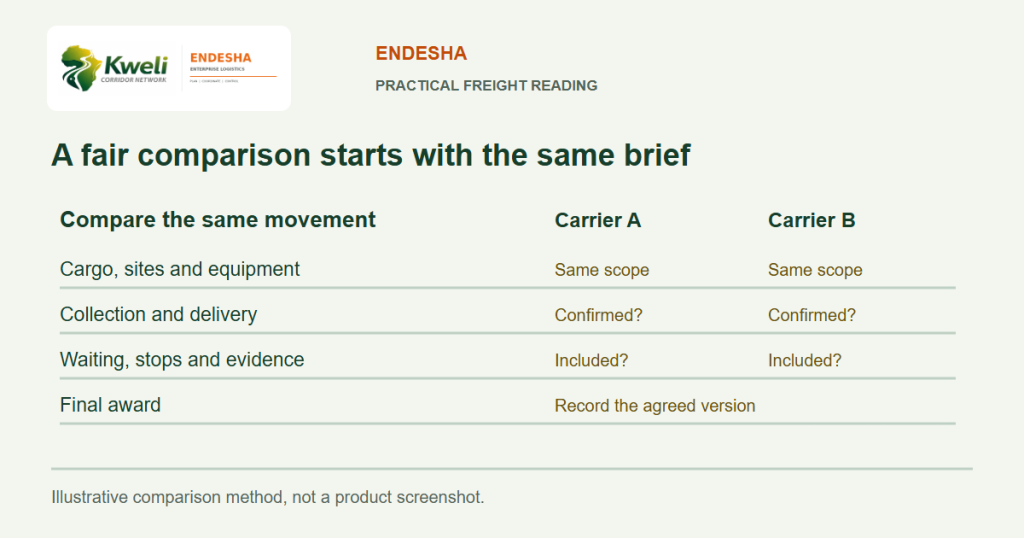
A freight request for quotation should describe the same complete movement to every carrier. Include cargo, sites, equipment, dates, price basis, exceptions and evidence requirements. Comparable instructions make carrier responses easier to assess and reduce assumptions that become disputes later.
A small transporter may have the right equipment but no dedicated tender office. An invitation that requires repeated calls for missing details puts that business at a disadvantage and consumes the shipper’s time too. Clear inputs help a capable operator give a responsible answer.
A practical RFQ brief
- Movement: actual collection and delivery points, not only city names.
- Cargo: quantity, mass, dimensions, packaging and relevant handling instructions.
- Equipment: body type and site-loading requirements, with suitability to be confirmed.
- Timing: loading window, delivery requirement and whether dates are fixed or indicative.
- Price: per trip, tonne or other stated basis; what must be included.
- Exceptions: waiting, additional stops, cancellations and scope changes.
- Administration: evidence, invoicing and proposed payment terms.
- Decision: response deadline, contact for questions and expected award process.
Separate a volume forecast from committed work
“Up to ten movements next month” is different from ten confirmed orders. Explain the forecast, notice period and how actual work will be awarded. A carrier should not reserve all capacity for a figure the shipper has not committed to buy.
For an illustrative repeated pallet movement, specify whether each load uses the same collection slot and delivery site. If the destination changes, require a scoped response rather than applying a single price to materially different jobs.
Choose the right enquiry channel
Free Kweli LX gives a shipper a route to the open market for specific large-truck B2B loads. Endesha is for higher-volume shipper planning, recurring work, bulk import and private RFQs to chosen carriers. It supports awards, with execution and POD followed through KITE.
Private does not mean the shipper can omit the brief. The selected carriers still need enough information to price and allocate responsibly. Endesha is offered by demo or pilot with volume-based agreement, rather than a self-service trial.
Answer one question for everyone who needs it
If a carrier discovers a material omission, clarify it consistently before comparing responses. Record the revision and allow a fair opportunity to update affected quotes. Keep internal assumptions distinguishable from confirmed customer requirements.
The free cost and quote tools can help a small carrier explain its inputs. The shipper’s task is to assess a suitable, sustainable service against the real requirement, not to treat every price difference as excess margin.
Practical questions
Can a forecast volume be treated as a guaranteed transport order?
No. State what is forecast, what is committed and how individual movements will be called off or awarded. Carriers need that distinction when planning capacity.
When is Endesha relevant instead of a single LX load post?
Endesha is aimed at recurring and higher-volume shipper work with chosen carriers, private RFQs and awards. Free LX remains a starting point for specific open-market large-truck loads.
Reviewed 7 November 2026. Examples are illustrative, not customer case studies. Product availability and current terms should be checked through official Kweli or Synesys guidance.