Echo Field Ops practical reading · Drivers, field teams and the people supporting them
A record saved on the phone is not proof that dispatch received it. Field teams need plain distinctions between local capture, a pending transmission and confirmed receipt. An unclear status can leave the driver believing the handover is complete while the office still waits.
This problem matters when a truck crosses a patchy-coverage area or a delivery site has poor reception. The useful question is what the system has confirmed, not whether the user tapped a button.
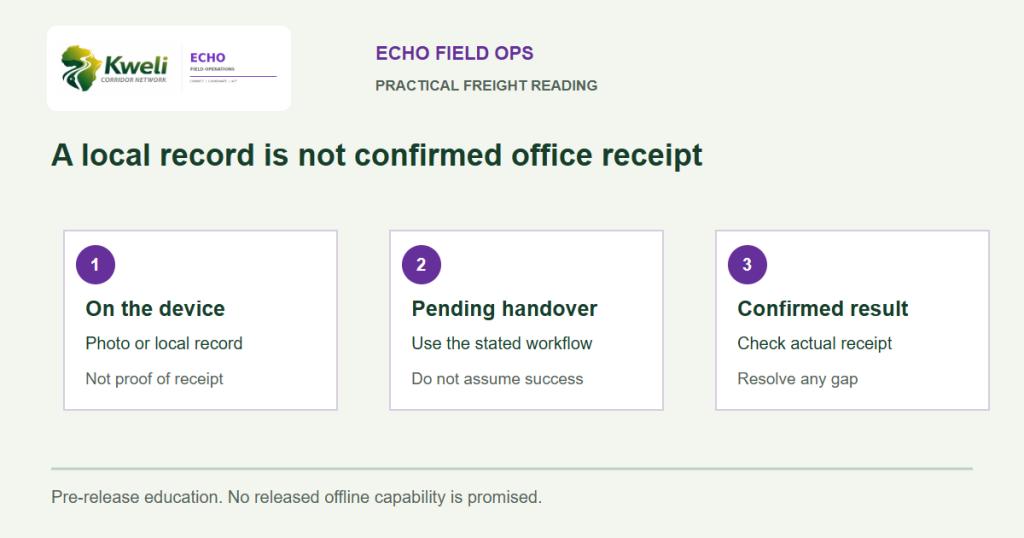
Use three questions for any mobile workflow
- Is it on this device? A local photograph or draft may still be useful evidence, but it has not necessarily left the phone.
- Is sending still pending? If a product supports a queue, its pending state should remain visible.
- Has the service accepted it? Check the actual receipt or result the current workflow provides.
These are concepts to explain during training, not a promise that every Hamba or Echo screen offers those exact labels. Do not assume an automatic retry or offline queue exists without checking the current product.
A practical fallback
Before departure, agree who the driver contacts if the evidence cannot be submitted and where it should be kept in the meantime. When safely parked with connectivity, check whether the earlier attempt arrived before creating duplicate or conflicting records.
For an illustrative POD, the driver takes a clear image at 14:10 but cannot confirm submission. The useful report is “photo captured; office receipt not yet confirmed”, followed by the agreed fallback. Saying “POD sent” hides the outstanding action.
Why this belongs in Echo Field Ops education
The Echo Field Ops design direction recognises the difference between device state and server-confirmed work. The app remains pre-release. This article explains the operational problem rather than promising a released offline capability or a particular retry schedule.
Hamba is the available driver browser portal. Check its live behaviour and ask dispatch for help when receipt is unclear. KITE supports execution evidence, but connectivity and human follow-through remain part of the handover.
Close the loop at the office
The receiver should identify missing evidence and respond with a specific request. “Need page two of the delivery document” is actionable; repeated “send POD” messages may leave both people working at cross-purposes.
The load may have started on free LX. Keeping its evidence dependable helps the small operator complete the business work after the truck has delivered, without pretending technology makes a weak connection disappear.
Practical questions
Does a photograph on the driver’s phone prove office receipt?
No. Local capture and confirmed receipt are different. Check the current workflow’s result and follow the agreed fallback if transmission is uncertain.
Does this article promise that Echo works fully offline?
No. Echo Field Ops is pre-release. The article explains how teams should distinguish local and confirmed information, without certifying a released offline feature set.
Reviewed 7 November 2026. Examples are illustrative, not customer case studies. Product availability and current terms should be checked through official Kweli or Synesys guidance.