A useful truck CPK is a complete and consistently measured cost per kilometre for your own operation. A low number is not an achievement if it leaves out maintenance, capital replacement, driver cost or empty travel. This guide does not publish a measured national CPK benchmark.
Start with the same unit and denominator
Operating CPK is cost divided by total kilometres driven over the same period. Include loaded and empty kilometres in that denominator. Cost per loaded kilometre, cost per paid kilometre and cost per tonne-kilometre answer different questions; label them clearly before comparing operators or vehicles.
Build the fixed-cost part
List the monthly costs your model must recover, such as finance-related cost, insurance, standing labour and overhead. Divide the selected fixed-cost total by realistic monthly kilometres. Be consistent about cash-flow planning versus economic costing, particularly finance repayments, depreciation and replacement provision, so the same capital cost is not counted twice or omitted.
Add variable costs per kilometre
Use your own fuel records, tyre life, maintenance provision and other running costs. Fuel CPK equals litres per 100 km multiplied by price per litre, divided by 100. Vehicle condition, route, traffic, cargo and operating practice affect the inputs. Check what is already inside your CPK before adding a separate trip charge.
A worked example with clear assumptions
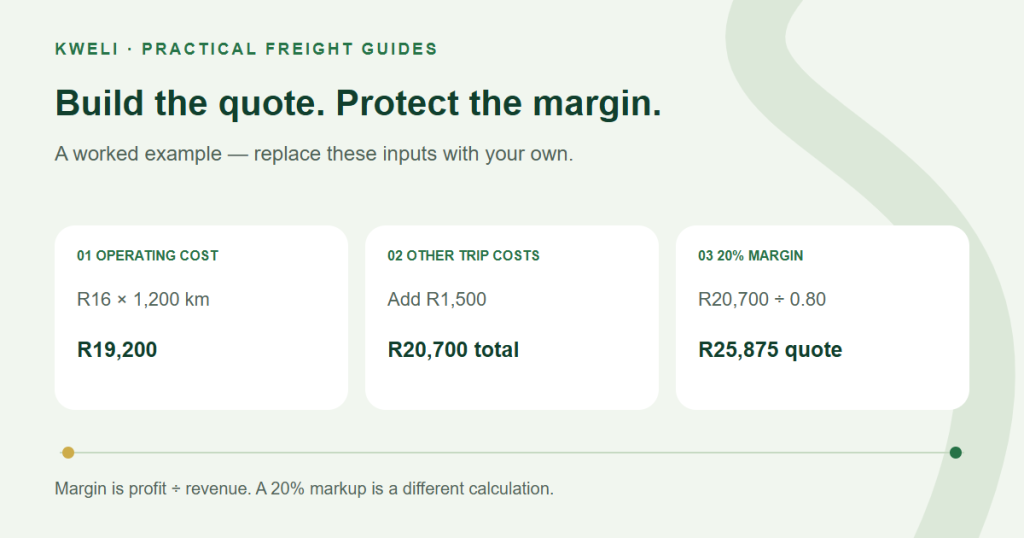
Assume R55,000 monthly fixed cost and 10,000 total kilometres: fixed cost is R5.50/km. At an illustrative 35 litres/100 km and R25/litre, fuel is R8.75/km. Add an illustrative R1.75/km for the other running costs included in this model: operating CPK is R16. These are demonstration inputs, not a current fuel price or an industry average.
See what utilisation changes
With the same R55,000 fixed cost but only 8,000 kilometres, the fixed part becomes R6.875/km. If the example’s variable inputs stay unchanged, total CPK rises to about R17.38/km. That is why standing time and a realistic kilometre budget matter. Carry the complete movement, including empty travel, into the freight quote tool.
Compare like for like, then review the outcome
Check whether a comparison includes VAT on the same basis, all relevant costs and the same distance unit. Payload changes cost per tonne-kilometre and may affect fuel use; it does not automatically spread monthly vehicle finance across more kilometres. Compare budget with actual invoices, fuel and distance records after the job. Use the load profit calculator for an offered amount.
Connect the numbers to the work
Use free LX to explore suitable large-truck freight without a commission on the LX deal. Optional KITE supports execution and close-out actuals; Atlas offers business software access to trusted Synesys partners under their partnership terms. Neither software nor a low CPK guarantees a profitable job. Read the complete calculator worked example.
Practical questions
What is a good CPK for a truck in South Africa?
Use a complete cost model for your own truck and compare equivalent inputs. There is no measured national benchmark on this page; a useful CPK must support a quote that covers the complete job and your chosen profit basis.
Does an owned truck have no capital cost?
Loan repayments may end, but an owned vehicle still needs maintenance and a consistent approach to capital replacement or depreciation. Choose a costing method that avoids omissions and double-counting.
Does carrying more tonnes automatically reduce vehicle CPK?
Not automatically. It can improve cost per tonne-kilometre, while vehicle CPK remains cost divided by kilometres and may change with fuel use or other operating costs.
Is adding 20% to cost the same as a 20% margin?
No. Multiplying cost by 1.20 gives a 20% markup. A 20% revenue margin requires cost divided by 0.80. Use the complete cost base in either calculation.
Content reviewed 7 November 2026. Examples are illustrative; use current inputs, the actual job brief and the live product terms.