Kweli Endesha is the enterprise shipper desk for companies moving freight at scale with a known group of carriers. It supports planning loads and recurring work, bulk import, private requests for quotes and awards. Awarded jobs move through execution and proof of delivery in Kweli KITE.
At low volume, a logistics coordinator can often remember every truck and chase every missing detail personally. With many movements, that approach starts to depend on who is available, which spreadsheet is current and whether the latest instruction reached the right person.
The difference between finding capacity and running a carrier programme
An open load exchange helps a shipper reach suitable operators for a proposed movement. A recurring freight programme also needs repeatable planning, a clear carrier shortlist, comparable quotations and a record of the award. Endesha is aimed at that second operating need.
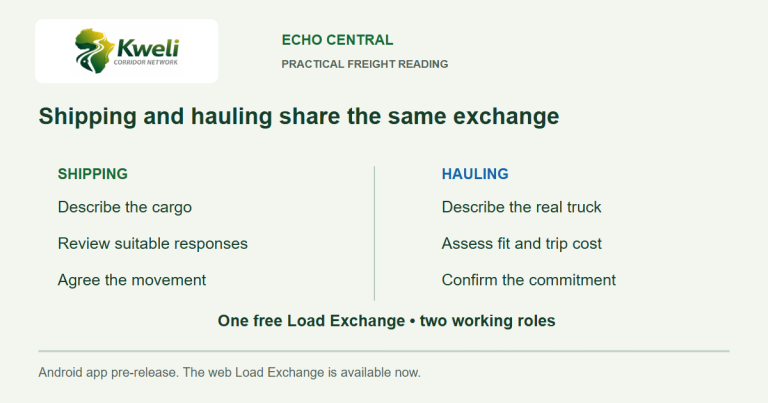
Free Kweli LX provides an open-market route for large-truck business freight. A shipper can start there when the immediate task is to post a load and review interested operators. Endesha becomes relevant when the team is coordinating higher volume with selected carriers.
A workable planning-to-award sequence
- Prepare the freight requirement. Keep route, cargo, equipment, timing and collection or delivery constraints together. Plan recurring work and use bulk import where it suits the operation.
- Choose the carrier group. A private request for quotes goes to the carriers the shipper selects.
- Ask for comparable responses. Give each carrier the same scope, including loading arrangements, waiting-time expectations and evidence requirements.
- Review and award. Assess the response against capacity, suitability, price and the working requirements of the load.
- Follow the awarded job. Use KITE for execution, active-job progress, proof of delivery and close-out.
What to include in a private request for quotes
A useful request identifies the actual work. State where it loads, where it delivers, what must be carried, the payload and dimensions, the equipment required, the dates and any site access constraints. Make the price basis clear, including the treatment of tolls, waiting, additional stops and the required delivery evidence.
A lower figure can cover a different scope. When the carrier and shipper are comparing the same movement, they can discuss a sustainable rate with fewer assumptions. The free freight calculators help operators explain the running costs behind their quotation.
Why the KITE handoff matters
Awarding the load is the start of execution. The carrier still has to allocate a truck and driver, collect, deliver and provide the agreed evidence. KITE follows the active job and keeps that evidence connected to the work. The team can then review what happened against what was awarded.
For example, a shipper planning repeated collections from one site can prepare a consistent brief, request quotations from its chosen carriers and carry the award into the job. Exceptions then have an agreed context rather than depending on a search through several message threads.
Who should explore Endesha?
Endesha is intended for enterprise shippers and logistics teams coordinating freight at scale. It is sold through a demo or pilot with pricing agreed for the volume. There is no self-serve trial. A productive demonstration starts with the team’s actual routes, load volumes, carrier relationships and handover problems.
Explore Endesha and the current product guide. If your immediate need is to find a truck for a single load, use the shipper starting guide.