Vuna practical reading · Owner-operators and growing transport businesses
A lead is worth progressing when you can establish who needs the transport, what must move and how a real decision will be made. Ask a few specific questions before preparing a detailed quotation or sending a sensitive document pack.
“We have regular loads; send your best rate” is an invitation to clarify, not enough information to price. The sender may be researching, seeking a backup carrier or forwarding somebody else’s enquiry. None of those situations should be presented to your team as an awarded load.
Use seven qualification questions
- Who is making the enquiry, and what is their role in the movement?
- What cargo, quantity, dimensions and handling requirements are known?
- What are the actual collection and delivery sites?
- When must it move, and is the date confirmed?
- What equipment and operating permissions are required?
- Who reviews the quote, and when will they decide?
- What is the price basis, invoicing requirement and proposed payment timing?
If a broker is involved, ask who they represent and what they are authorised to do. A familiar company name in a message is not proof of authority. Confirm material details through an appropriate known contact and keep an account of the confirmation.
Give the enquiry a realistic next step
For example, a prospect asks about weekly freight to a regional distribution centre but cannot yet confirm mass or loading days. Your next step might be “send equipment profile; await cargo schedule before pricing”. It should not be “reserve Tuesday truck” or “forecast weekly revenue”.
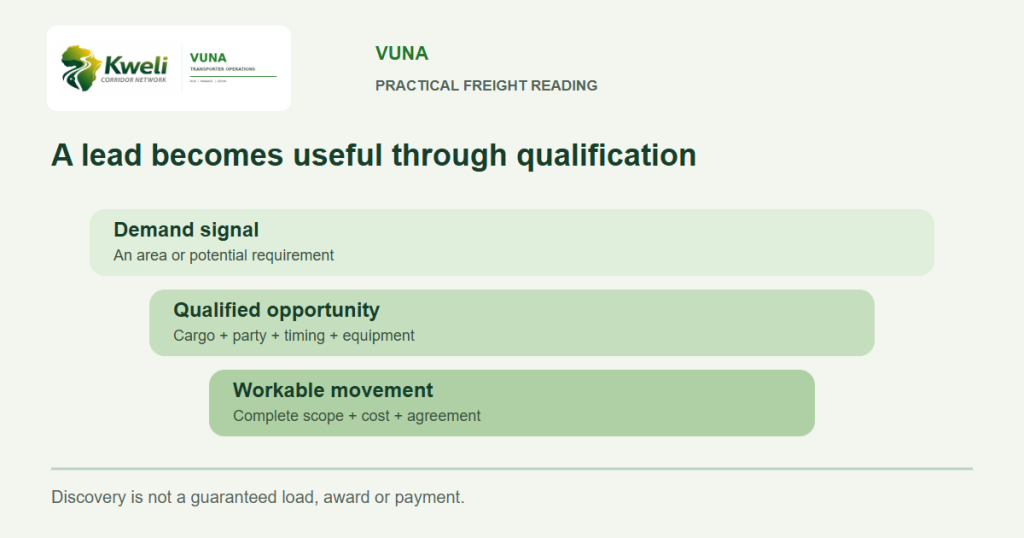
Use three simple outcomes: ready to quote, needs information, or outside our capability. These are suggested working labels for your own prospect record. A polite decline can save time and preserve a relationship when the equipment or route does not fit.
Use Vuna and LX at the right stage
Vuna supports discovery of leads and freight demand. Availability is rolling out by organisation. Qualification is the operator’s next task; discovery is not a guarantee of genuine cargo, award or payment.
For an actual large-truck B2B load, free LX gives the parties a place to find and agree work. The operator still needs to assess the party, equipment fit and terms. Optional products do not remove that judgement.
Protect time and information together
Provide a relevant capacity summary first. Send necessary documents through the intended process once the recipient and purpose are understood. Avoid circulating identity records or credentials to a chain of unknown intermediaries simply because somebody promises high volumes.
Finally, price the complete trip using your operating costs. A qualified enquiry can still be commercially unsuitable; being able to quote does not mean the business should accept.
Practical questions
What is the difference between a freight lead and an agreed load?
A lead indicates possible demand. An agreed load has a defined movement and accepted terms between the relevant parties; capacity and execution still need to be confirmed.
Should a promised weekly volume go into my revenue forecast immediately?
No. Distinguish a general enquiry, a quote request, a confirmed award and completed billable work. Do not budget on unsupported volume promises.
Reviewed 7 November 2026. Examples are illustrative, not customer case studies. Product availability and current terms should be checked through official Kweli or Synesys guidance.