Vuna practical reading · Owner-operators and growing transport businesses
Choose a freight lane by the work your business can reliably serve and the complete cost of serving it. Demand in a region is only a starting signal. It does not show that a suitable load will be available on your date or that the rate will support your truck.
A small operator has limited time for prospecting. Following every rumour of busy warehouses can leave the vehicle far from its base and the owner spending money before a job is agreed. Compare a few realistic lane options before expanding your search.
Ask five questions about the lane
- Does the freight fit? Identify cargo, body type, loading method and any special requirements.
- Can you reach collection? Include the empty approach and real readiness date.
- Can you complete it reliably? Assess sites, timing, operating countries and the people needed for handovers.
- What follows delivery? Consider a realistic return plan without assuming a paid backhaul.
- Can the business fund it? Compare trip cash needs with agreed payment timing.
Compare uncertainty, not just headline rates
In an illustrative comparison, lane A offers R24,000 for 1,000 total planned kilometres; lane B offers R28,000 for 1,500. At an assumed R16 operating CPK, the included distance costs are R16,000 and R24,000. Before other costs, the apparent contribution is R8,000 on A and R4,000 on B.
The inputs are teaching values, not current market rates. Site delays, cargo requirements, tolls and payment risks can change the result. Use your own CPK and trip inputs, and avoid counting a cost twice.
Keep a lane notebook
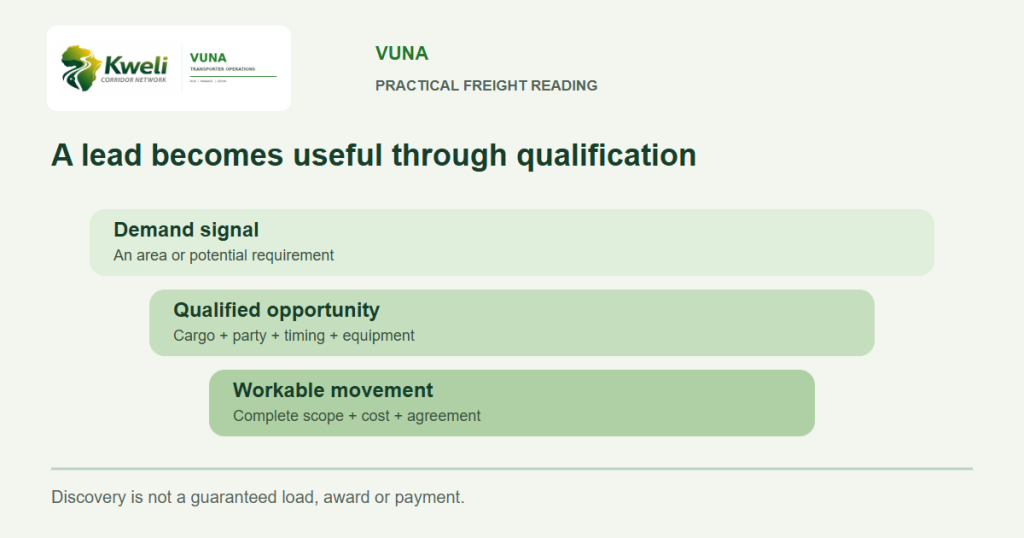
Record the source and date of each demand signal, relevant customer type, equipment needed, unanswered questions and the next sensible action. Separate “a manufacturer exists here” from “that manufacturer has invited a quote”. This prevents a broad market observation from becoming an imaginary pipeline.
Vuna helps transport businesses discover demand beyond familiar relationships. Use it to inform the shortlist, then qualify the specific opportunity. Vuna is rolling out and availability is organisation-dependent; it does not guarantee work.
Test the lane with a movement you understand
Use free LX to find or post specific large-truck B2B freight. Before applying, confirm the actual route, counterparty, timing and full terms. One successful trip can teach you about a lane, but it does not establish a dependable weekly contract.
After the job, compare the planned and actual distance, waiting and costs. Expand the lane only when the operating evidence supports it. That gives a small business a more sustainable basis for growth than chasing the largest advertised price.
Practical questions
Does high freight activity mean my truck will find work there?
No. You still need a suitable load on the right date, an acceptable counterparty, workable requirements and commercial terms that cover your operation.
Should I include an unconfirmed return load in my base quote?
Treat it as an uncertain scenario. Check whether the trip still works if the return is empty, unless a separate return movement is actually agreed.
Reviewed 7 November 2026. Examples are illustrative, not customer case studies. Product availability and current terms should be checked through official Kweli or Synesys guidance.