
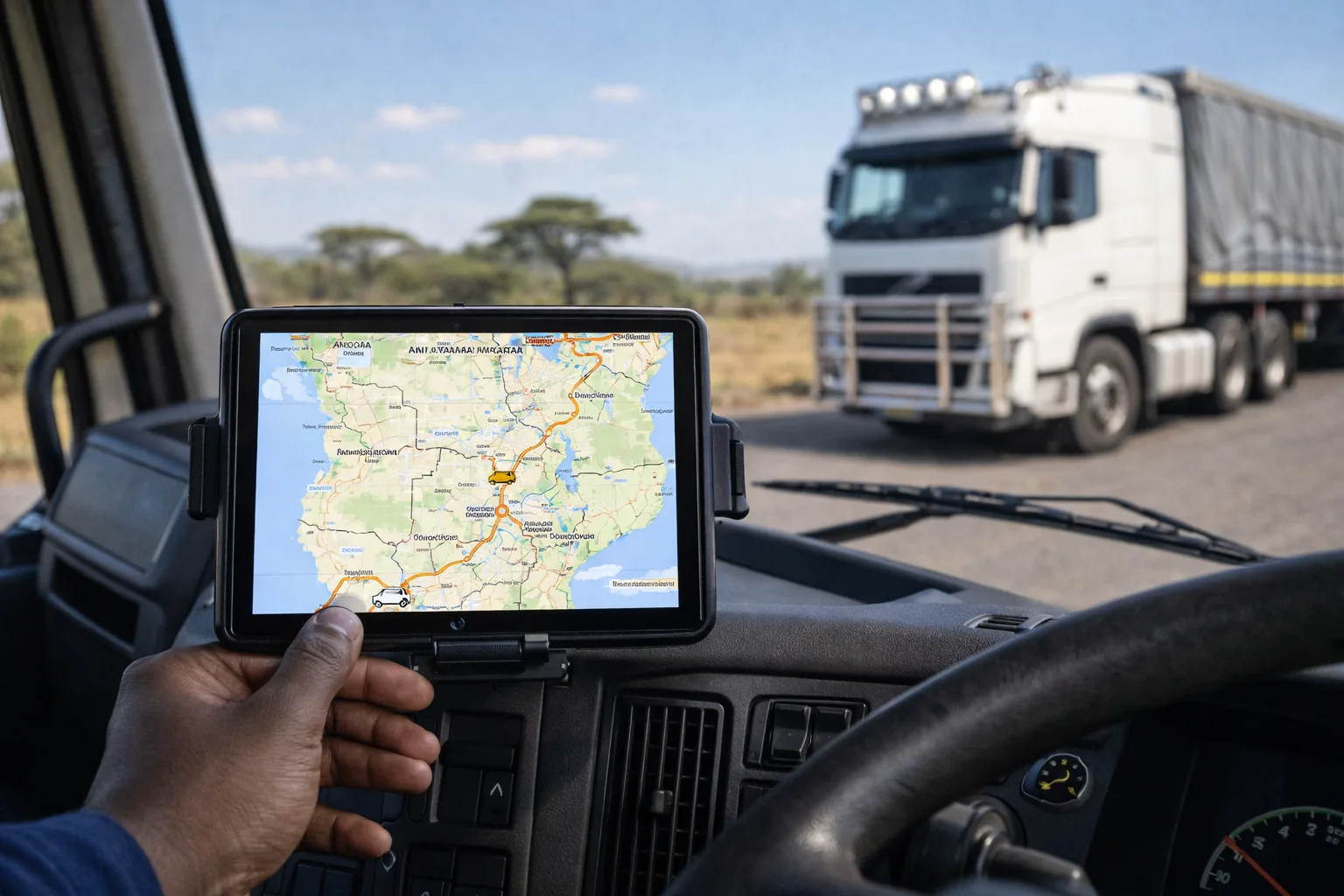

Cross-border logistics in the Southern African Development Community (SADC) region moves an estimated $30 billion worth of freight every year. Yet most operators still struggle with one fundamental question: how do you actually track transport across these corridors?
Transport tracking in SADC is not a single technology problem. It spans GPS hardware, border processes, communication channels, operational trust and corridor-specific coordination. Most solutions address only one layer and leave operators guessing about the rest.
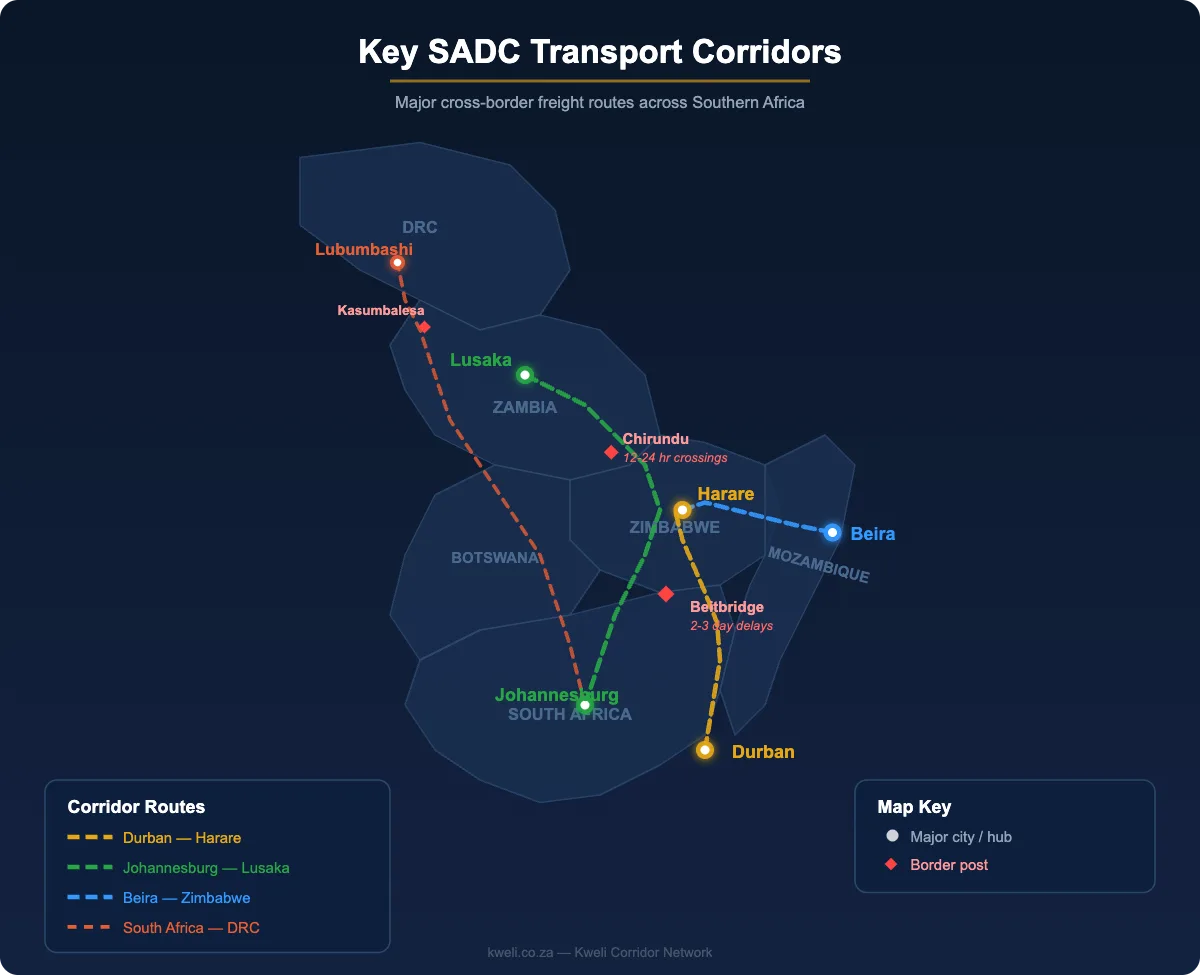
Corridors like Durban to Harare, Johannesburg to Lusaka, Beira to Zimbabwe and South Africa to DRC each present unique tracking challenges. Border delays at crossings like Beitbridge can add two to three days to a single trip. Fuel shortages, customs bottlenecks and regulatory differences between SADC member states create further blind spots that no GPS system can resolve on its own.
This article breaks down the five essential layers of transport tracking in SADC and explains what actually works for operators, shippers and brokers moving freight across Southern Africa.

1. GPS and Telematics: The Foundation of Fleet Visibility
Most medium and large fleets operating across SADC corridors use some form of GPS-based tracking. Common systems include vehicle-mounted GPS devices, telematics platforms and fleet management dashboards from providers like Ctrack, MiX Telematics and Cartrack. For many operators, GPS is the starting point of transport tracking in SADC.
These systems provide real-time vehicle position, route history, speed monitoring, driver behaviour analysis and geofencing alerts. For fleet owners running 10 or more trucks, telematics is typically the first investment in operational visibility.
What GPS Does Well
GPS tracking excels at answering one question: where is the truck right now? For fleet managers monitoring multiple vehicles across long corridors, this visibility is essential. It helps with route compliance, estimated arrival times and theft recovery.
According to industry estimates, fleet tracking adoption among formal operators in South Africa exceeds 70 percent. However, adoption rates drop significantly among smaller operators and owner-drivers who make up a large portion of SADC cross-border transport.
Where GPS Falls Short
GPS alone does not solve coordination problems. A truck can be visible on a dashboard but still be delayed at a border, double-booked by a broker or redirected without notice. GPS tells you location but not context. This is the first major limitation of transport tracking in SADC.
For cross-border logistics, the gap between visibility and coordination is where most tracking failures occur. Knowing a truck is stationary at Beitbridge for 48 hours tells you nothing about whether documentation is compliant, whether the load has been reassigned or whether the driver is contactable. Effective transport tracking in SADC must go beyond location data alone.
2. Border and Corridor Delay Tracking
Cross-border transport tracking in SADC is heavily affected by conditions at border posts and along corridor routes. The major delays include border congestion, customs clearance processes, roadblocks and inspections, fuel shortages and regulatory inconsistencies between countries.
The Real Cost of Border Delays
Border delays are not just an inconvenience. Industry data from the TradeMark Africa corridor performance reports shows that trucks crossing at Beitbridge (South Africa to Zimbabwe) can wait two to three days during peak periods. At Chirundu One-Stop Border Post, average crossing times range from 12 to 24 hours.
Each day of delay costs a truck operator between $200 and $500 in direct costs including driver wages, fuel for idling, opportunity cost of missed loads and potential penalties from shippers.
Why GPS Cannot Track Delays
GPS may show that a vehicle has stopped moving. But it does not reveal why a truck is stopped, whether documentation is compliant, whether cargo has been re-assigned or when clearance is expected.
Effective corridor tracking requires operational communication that sits alongside GPS data. This means structured status updates from drivers, border agents or coordinators who can provide context that technology alone cannot deliver.
Many operators along the SADC North-South Corridor have experienced this gap first-hand. The corridor stretches from Durban through Zimbabwe and Zambia to the DRC, crossing multiple borders where delays compound with each crossing.
3. Communication-Based Tracking
In Southern Africa, much of the day-to-day coordination between shippers, transporters and brokers happens through informal channels. WhatsApp load groups remain the dominant communication tool, supplemented by direct phone calls, brokers and informal load exchanges.
Facebook load groups also play a role, particularly for finding available trucks or loads. However, both platforms were designed for social communication, not logistics coordination.
The Communication Tracking Problem
This informal approach creates several problems for transport tracking in SADC:
- Promised trucks go cold without notice
- Promised loads disappear after verbal commitments
- There is no structured performance record across deals
- No central rate reference exists per corridor
- Messages are buried within hours in high-volume groups
The result is that tracking becomes reactive rather than structured. Operators spend significant time chasing updates rather than receiving them through a reliable system.
Why Structure Matters
The difference between informal and structured communication tracking is accountability. In an unstructured WhatsApp group with 200 members, there is no record of who committed to what. A transporter who fails to show up faces no documented consequence.
Structured communication tracking records commitments, timestamps responses and builds a history of operational behaviour. This transforms tracking from a one-time location check into an ongoing assessment of reliability.
4. Operational History and Accountability
A major gap in transport tracking in SADC corridors is the absence of recorded operational history. Most deals happen once and are forgotten. There is no accumulation of data about how operators behave over time.
This means every new transaction starts from zero trust. A shipper has no way to verify whether a transporter delivered on time last month. A transporter has no way to prove their track record to a new client.
The Trust Problem in SADC Freight
Trust in SADC logistics is built through personal relationships and word of mouth. While this works within small networks, it does not scale across corridors or between unfamiliar parties.
Without operational memory, tracking resets on every deal. There is no accumulation of reliability data. A transporter with a perfect 50-delivery record looks identical to one with a history of no-shows. This is why transport tracking in SADC requires an accountability layer that most systems lack.
Building Accountability Through Data
Effective accountability tracking requires recording commitment history, delivery consistency, response times and corridor-specific performance. This data must be structured per user and per corridor to be meaningful.
Over time, this creates a trust layer that sits above GPS tracking and communication. It answers not just “where is the truck” but “can this operator be relied upon” based on documented evidence rather than assumption.
5. Corridor-Based Coordination
An emerging approach to transport tracking in SADC is corridor-based coordination. Instead of broad, unfocused group chatter, loads and transport are structured by specific trade routes.
This means organising information by corridor (such as Durban to Harare or Johannesburg to Lusaka), by vehicle type (flatbed, side-tipper, tautliner, tanker) and by operational history.
Benefits of Corridor Focus
When operators focus on specific corridors, several benefits emerge:
- Rate clarity: Participants develop realistic rate expectations per corridor
- Better matching: Loads are only shown to operators who service that route
- Reduced noise: Irrelevant messages from other corridors are eliminated
- Structured relationships: Repeat interactions on the same corridor build familiarity
Corridor-based coordination improves decision-making over time because the data is relevant and focused rather than scattered across hundreds of routes.
From Tracking to Coordination
The shift from tracking to coordination represents the future of trucking logistics in Southern Africa. Tracking answers “where is it now?” Coordination answers “who is available, what is the rate, and can they be trusted?”
This requires combining GPS visibility, border status awareness, structured communication, operational history and corridor-specific data into a single workflow rather than managing five separate systems.
Comparison: Transport Tracking Methods in SADC
The following table compares the five main approaches to transport tracking in SADC based on visibility, coordination capability, trust building and cost.
| Method | Visibility | Coordination | Trust Building | Cost |
|---|---|---|---|---|
| GPS/Telematics | High | Low | None | High (hardware + subscription) |
| WhatsApp Groups | Low | Medium | None | Free |
| Facebook Groups | Low | Low | None | Free |
| Phone/Broker Networks | Medium | Medium | Informal only | Variable |
| Corridor-Based Platforms | Medium | High | Structured | Varies |
Where Kweli Corridor Network Fits
Kweli is not a GPS tracking platform. It does not replace fleet telematics or compete with hardware-based tracking systems.
Kweli focuses on coordination tracking at the exchange level. This means:
- Loads are structured by corridor
- Trucks are described by vehicle and trailer type
- User interactions are recorded as operational history
- There are no subscriptions or commissions
Kweli runs in your browser at lx.kweli.co.za and is WhatsApp-integrated, so operators do not need to download a new app or learn a new system. The Kweli platform features are designed around the way Southern African logistics already works, with structured intelligence layered on top.
The objective is not to track vehicles. It is to track commitments and operational consistency across SADC corridors. You can join Kweli Corridor Network to experience structured corridor coordination first-hand.
Final Thought
In SADC logistics, tracking must move beyond dots on a map. Effective transport coordination requires visibility, structure, recorded operational behaviour and corridor-specific focus.
Operators who rely solely on GPS miss the coordination layer. Those who rely solely on WhatsApp groups miss the accountability layer. The future of transport tracking in SADC lies in combining these layers into a single, structured approach.
Transport across Southern Africa is complex. Tracking must reflect that complexity.
FAQ: Tracking Transport Across SADC Corridors
1. How do companies track transport across SADC corridors?
Most companies approach transport tracking in SADC through GPS and telematics systems to monitor vehicle location. However, effective tracking across SADC corridors also requires operational coordination, customs documentation monitoring and structured communication between shippers and transporters.
2. Is GPS tracking enough for cross-border logistics in Southern Africa?
No. GPS provides location data but does not show border clearance delays, documentation issues, load reassignments or commitment failures. Effective cross-border coordination requires structured communication and operational record-keeping alongside GPS.
3. Why do loads and trucks often go cold in WhatsApp and Facebook groups?
In open groups, commitments are informal, there is no central record of past behaviour, there is no structured corridor focus and messages are quickly buried. Without operational memory, accountability is limited.
4. What is corridor-based transport coordination?
Corridor-based coordination structures loads and transporters by specific trade routes such as Durban to Harare, Johannesburg to Lusaka and South Africa to DRC. This reduces noise and improves decision-making because participants focus only on relevant routes.
5. Does Kweli provide GPS vehicle tracking?
No. Kweli is not a telematics or GPS tracking system. Kweli is a WhatsApp-integrated load exchange that structures loads by corridor and records operational interactions over time.
6. How does Kweli improve transport coordination in SADC?
Kweli improves transport tracking in SADC by structuring loads per corridor, describing trucks by vehicle and trailer type, recording user interactions as operational history and charging no subscriptions or commissions.
7. What are the biggest border delays affecting SADC transport?
The worst delays occur at high-volume border posts like Beitbridge (South Africa-Zimbabwe) where waits of 2-3 days are common during peak periods. Chirundu One-Stop Border Post averages 12-24 hours. Each day of delay costs operators $200-500 in direct costs.
Transport Tracking Solutions for Owner-Operators in Southern Africa
Transport tracking for owner-operators in Southern Africa has become significantly more accessible as smartphone-based GPS applications have reduced the cost of entry-level tracking to near zero. Where enterprise transport tracking systems once required dedicated hardware, server infrastructure and IT support, an owner-operator today can implement basic transport tracking using a smartphone app and a monthly subscription that costs less than a single tank of diesel. This democratisation of transport tracking technology has changed what shippers expect from independent operators — and operators who cannot offer any form of transport tracking visibility are increasingly at a disadvantage when competing for freight against operators who can.
What Shippers Expect From Transport Tracking
Shipper expectations around transport tracking vary by industry and cargo value. Retailers and FMCG distributors with just-in-time supply chains expect real-time transport tracking updates so they can plan receiving schedules and alert store managers to any delivery delays. Mining companies moving high-value minerals require transport tracking combined with tamper alerts and driver behaviour monitoring. Agricultural shippers moving perishable cargo need transport tracking integrated with temperature monitoring to verify cold chain integrity. Understanding what level of transport tracking your target shippers require helps operators invest appropriately rather than over-specifying or under-specifying their transport tracking capability.
Cross-Border Transport Tracking Challenges in SADC
Cross-border transport tracking on SADC corridors presents specific challenges that domestic transport tracking does not face. Network coverage gaps on rural sections of cross-border routes mean transport tracking systems that rely on cellular data may lose visibility for extended periods. Border crossings create delays that transport tracking systems should flag differently from normal transit time, but many basic systems do not distinguish between border waiting time and in-transit movement. Transport tracking data from cross-border trips must also comply with data privacy regulations in multiple jurisdictions, which is rarely a concern for domestic transport tracking but becomes relevant for larger fleets operating internationally.
Despite these challenges, cross-border transport tracking is valuable precisely because the distances and transit times involved are so much greater. A Johannesburg to Harare load that takes 48 to 72 hours in transit with potential border delays gives both the shipper and the operator far more opportunity to benefit from transport tracking visibility than a same-day domestic delivery. Operators who invest in reliable cross-border transport tracking capability build the kind of shipper confidence that generates repeat business and direct load relationships.
For a full overview of how to find and manage loads on SADC cross-border routes, read our guide to finding loads for trucks in Southern Africa.
💬 Transport Tracking — Community on Kweli Pulse
Join Southern Africa’s freight community on Kweli Pulse — where operators, cargo owners, and brokers discuss rates, routes, and opportunities in real time.
- On The Road — Driver check-ins, road conditions, and cargo tracking tips.
- Operators’ Corner — Fleet tracking tools and operational best practices.
Kweli Load Exchange
Now find a load for your truck — or a truck for your load
Free for transporters and shippers. No commission, no subscription.
Local
and cross-border
See
who you are dealing with
R0
commission, always
List your truck and its corridors, or post a load. Your corridors decide which loads we show you first — they do not lock you out of the rest. Body, weight, fit, papers: we show them, and you decide.
WhatsApp-integrated · your number is your account. Nothing from an app store — you finish with your trucks and their corridors on the board.
New to Kweli? See what the network does → — load exchange, driver registry and the Pulse community.

