Echo Central practical reading · Shippers, carriers and mobile business owners
An application expresses interest; a negotiation changes or clarifies terms; an agreed job requires the relevant acceptance. Check the current movement and commercial state before treating the work as won. A promising conversation should not become a dispatch instruction by accident.
For an owner working from a phone, several load conversations can be open at once. One customer asks for a lower price, another has not replied, and a third needs different equipment. Keeping those states clear protects the truck from conflicting promises.
Review the actual offer
- Which load and business does the response concern?
- What rate and unit are being offered?
- Are sites, dates, cargo and equipment unchanged?
- What payment and evidence requirements apply?
- Is your truck still available for that collection?
- What action does the current workflow require to accept or decline?
Do not read a new price as the whole agreement if other requirements have changed. If a tonne rate is shown, confirm the quantity basis; a per-trip price and a per-tonne figure are not interchangeable.
Keep the truck’s availability honest
In an illustrative case, a carrier applies for two possible Thursday loads but can perform only one. Once work is actually agreed, the operator needs to handle its remaining applications and communications appropriately. Do not leave another party believing capacity is committed when it is already allocated elsewhere.
Likewise, a customer’s counteroffer should prompt a fresh cost check. The free calculators help assess a complete trip; they do not tell you what every carrier ought to charge.
Why this matters for Echo Central
Echo Central is intended to bring Load Exchange application and deal workflows into a native Android experience. It remains pre-release. This article explains the business distinctions, not final button names or a publicly available Android journey.
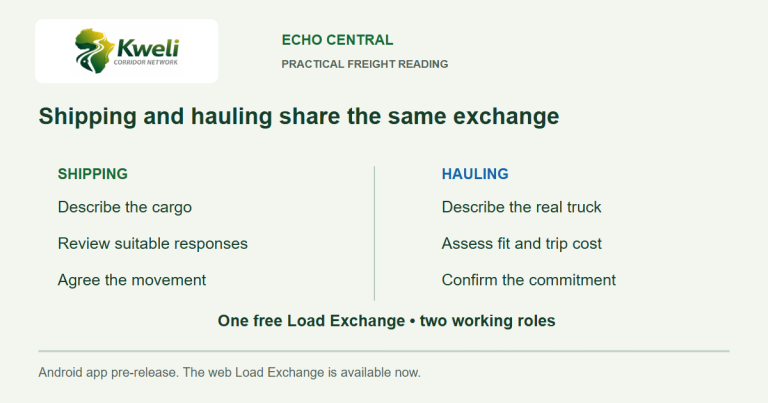
Use free LX through the current web route today. The free exchange introduces and supports agreement on suitable large-truck B2B work; optional tools have separate terms.
Hand the accepted job to execution
Once the parties have agreed, prepare the actual dispatch brief, allocate suitable resources and confirm the first action. KITE supports paid execution after agreement. The shift from interest to commitment should be explicit enough that the owner, dispatcher and driver all understand it.
Practical questions
Does a load application authorise dispatch?
No. Confirm an actual agreement, suitable resources and a complete operating brief before dispatching.
Should I review availability when responding to a counteroffer?
Yes. The truck’s situation and the job scope may have changed since the application. Recheck both before accepting.
Reviewed 7 November 2026. Examples are illustrative, not customer case studies. Product availability and current terms should be checked through official Kweli or Synesys guidance.