Port guides · Corridors and major road lanes
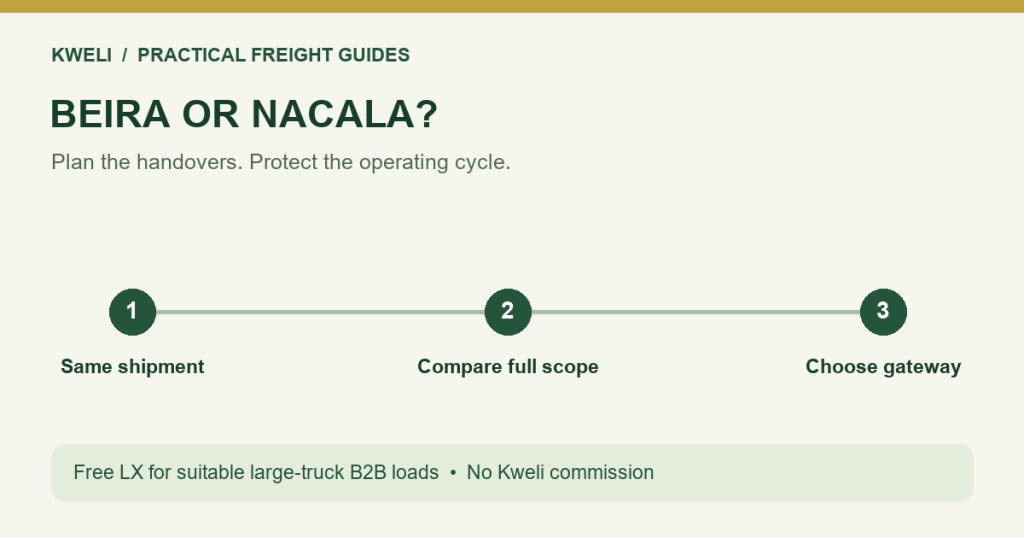
Neither Beira nor Nacala is the best gateway for every shipment. Compare them using the same inland site, cargo, service scope and required date. The useful answer is a complete movement plan, not a universal winner based on a port name or one distance.
First decide what you are comparing
Beira and Nacala are different Mozambique gateways with different inland connections. Consult Cornelder’s Beira information and CFM’s Nacala directory for gateway context. Then obtain job-specific proposals from the responsible shipping, terminal, forwarding and road parties. This guide offers a comparison method rather than live port performance rankings.
Write one common shipment brief: actual inland collection and delivery sites, cargo, mass, dimensions, container or handling requirements, readiness date and required evidence. Without that common brief, the cheaper quote may simply omit a leg or obligation.
Keep modes and handovers explicit
| Question | What to record for each gateway |
|---|---|
| Road or rail? | The proposed mode on each leg, actual itinerary and transfer point. |
| Which facilities? | Named terminal, depot, border and receiving site. |
| Who handles release? | Responsible agent, reference and escalation contact. |
| Which truck? | Suitable equipment and loading or unloading capability. |
| What is included? | Line-haul, local moves, handovers, waiting terms and returns. |
| When is it usable? | Current readiness and service confirmations, with assumptions identified. |
Do not compare a rail corridor distance on one side with a road quote on the other as if they describe the same work. If a proposal is multimodal, ask who owns each transfer and what happens when a connection is missed. Infrastructure availability is different from a confirmed service for your consignment.
Compare cost and cash timing together
For the road carrier, include the empty approach, loaded leg, local travel, time exposure and next position. For the shipper, establish which costs sit outside the carrier’s scope. Record the currency and basis of each current quotation. Avoid mixing an old published tariff with a new all-in quote without explaining the difference.
Consider an illustrative small operator offered two different gateway jobs. One has a lower line-haul rate but clearer release and a suitable next load; the other has a higher rate but uncertain collection and expensive repositioning. Compare confirmed facts, then test a conservative scenario where the hoped-for backload never materialises. Do not treat either example as evidence that one port is always faster.
Make a decision the people doing the job can use
Record why the gateway was chosen, which assumptions remain open and who confirms them. Recheck before dispatch. After delivery, compare the estimate with the actual handovers and costs so the next decision benefits from your own experience.
Free LX can help find or post a specific suitable large-truck B2B movement once the brief is clear. It does not choose the port, clear the cargo or guarantee a backload. The free calculators help test your own cost inputs; optional KITE supports the agreed movement’s dispatch, progress and evidence.
Practical questions
Is Beira always cheaper than Nacala for road freight?
No. Compare the same inland sites, cargo, equipment, complete service scope and current job-specific costs. A port name or one distance cannot establish the cheaper completed movement.
What is the most important Beira–Nacala comparison mistake to avoid?
Do not mix road and rail distances, service assumptions or omitted handovers. Compare equivalent movements and label what remains unconfirmed.
Official sources and current checks
Reviewed 7 November 2026. General planning guidance, not live terminal status, approved routing, customs advice or a tariff. Confirm current instructions for the actual consignment with the responsible parties.