Hamba practical reading · Drivers, dispatchers and small fleet owners
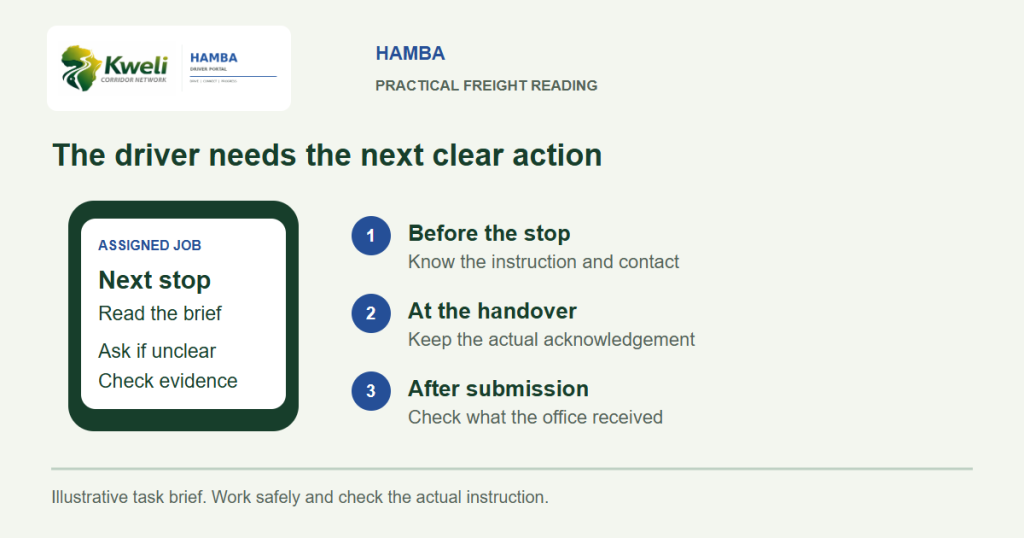
Hamba’s published scope is location during an active job assigned to the driver, ending when the job is closed. Explain that purpose before work starts. Drivers should know which movement they are supporting and who to ask about job settings.
Trust is harder to build when the office says only “allow everything”. A useful briefing explains the job, the information required and the practical limits. It should not make promises about phone behaviour that the team has not checked.
Use four plain questions
- Which assigned job is active?
- Why does the operation need location evidence for it?
- Who can see the relevant job information under its settings?
- What should the driver do if access or location appears wrong?
Hamba is free for drivers and shows their assigned work. Kweli’s published terms describe location for the active load, with shipper visibility dependent on transporter job settings. The carrier’s separate GPS or telematics system remains separate.
A map point is not the whole story
A saved location can be older than the moment someone views it. Device power, connection quality and updates can affect freshness. A point near collection does not prove loading has started, and an absent new point does not by itself prove wrongdoing.
For an illustrative stale update, dispatch should check the last update time, current job state and device situation. Contact the driver through the agreed safe method where necessary. Do not instruct a moving driver to troubleshoot permissions while driving.
Check the end of the job
Because the location boundary relates to an active job, close-out matters. Ask the office to confirm the movement has been handled through its proper closure process. If the driver believes location access continues unexpectedly, report the observation for investigation rather than relying on a general reassurance.
This article explains the published product boundary. It is not a legal assessment of an employer’s wider monitoring arrangements. The applicable privacy notice and terms remain the place to review platform data handling.
Keep the product roles distinct
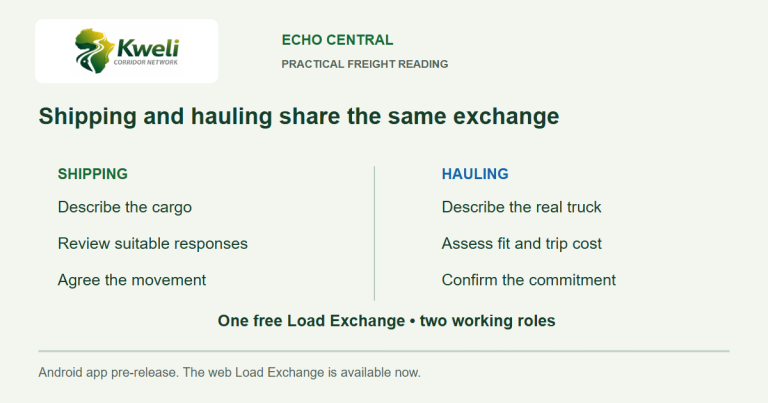
Free LX is where suitable large-truck B2B work can be found and agreed. KITE supports active-job execution; Hamba gives the assigned driver a browser route. Echo Field Ops is pre-release, so its future native experience should not be described as required for today’s Hamba work.
A clear explanation and a responsive support process are practical parts of digital enablement. The driver is a participant in the movement, not merely a source of location points.
Practical questions
Is Hamba intended to record location outside an assigned active job?
No. Its published scope is the active job assigned to the driver, from trip tracking until closure. Report any behaviour that appears inconsistent with that boundary.
Does a location pin prove that loading or delivery is complete?
No. Check the relevant job event and evidence. Location alone does not establish cargo handling or recipient acceptance.
Reviewed 7 November 2026. Examples are illustrative, not customer case studies. Product availability and current terms should be checked through official Kweli or Synesys guidance.