KITE practical reading · Owners, dispatchers and freight coordinators
After a load, compare what you priced with what the truck actually did. Review the route, costs, waiting, delivery evidence and unresolved commercial points. The purpose is to improve the next decision while the details are still easy to recover.
A full management meeting is unnecessary for every small job. A short review can identify whether the quote omitted an empty approach, the collection window was unrealistic or administration is still missing the POD. Use a longer investigation when safety, loss, damage or a dispute requires it.
Bring four parts of the record together
- The agreement: scope, rate basis, payment terms and approved changes.
- The movement: actual sites, distance, collection and delivery events.
- The evidence: POD, receipts and recorded exceptions.
- The cost: actual variable costs plus a consistent allocation of the business’s other operating costs.
Separate missing data from zero cost. A fuel receipt you have not entered is not free diesel. Likewise, an unpaid invoice is not automatically a bad debt, but it is also not available cash.
A worked variance example
Assume, purely for illustration, that you planned 1,000 total kilometres at R16 operating cost per kilometre and R1,000 in other trip costs: R17,000. The truck actually travelled 1,100 kilometres. At the same assumed CPK, estimated trip cost becomes R18,600 before any other change. The extra 100 kilometres add R1,600.
If agreed revenue was R22,000, the illustrative contribution after those included costs falls from R5,000 to R3,400. This is not a national CPK benchmark or a complete accounting profit statement. Do not add fuel again if the R16 already includes it. Replace the example with your records in the free calculators.
Find one action for the next job
Ask why the extra distance happened. A legitimate site change may require a better variation process. A poor original route estimate may require depot-to-depot planning. Repeated waiting may require different booking assumptions. Record one change and a person responsible rather than collecting numbers nobody uses.
Where execution records help
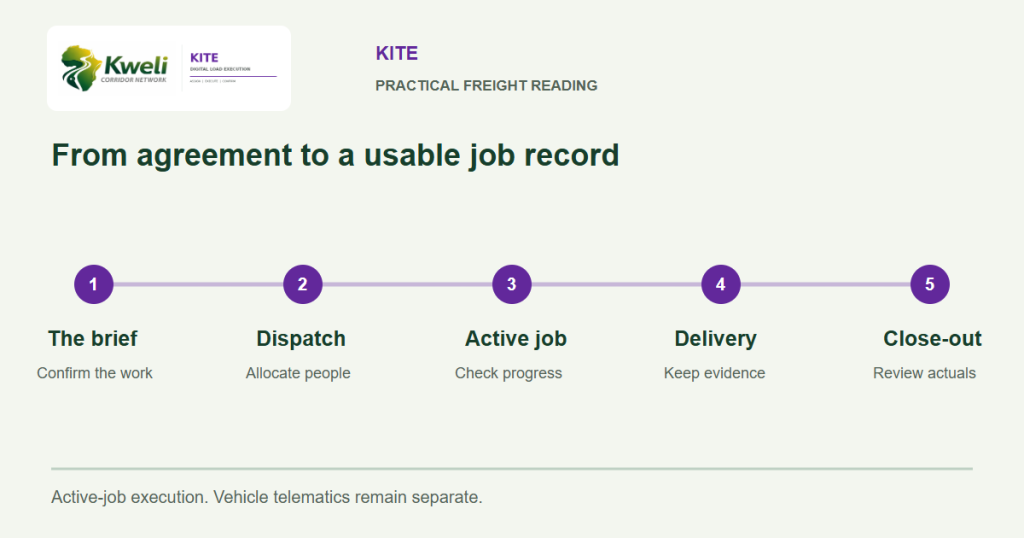
KITE connects planning and dispatch with active-job progress, delivery evidence and close-out with actuals. Use that job context to support the review; do not assume every business expense is captured automatically or that KITE replaces accounting advice.
Whether work came through free LX or an established customer, the learning belongs to the operator. A better next quote starts with understanding the last movement, not copying another transporter’s headline rate.
Practical questions
What is the difference between trip contribution and accounting profit?
Trip contribution deducts the costs included in that calculation from revenue. A complete profit assessment must also account consistently for the business’s remaining costs and accounting treatment.
Should fuel be added to a quote that already uses an all-in operating CPK?
Not again if fuel is already included. Define what your CPK contains and add only costs that have not already been counted.
Reviewed 7 November 2026. Examples are illustrative, not customer case studies. Product availability and current terms should be checked through official Kweli or Synesys guidance.