KITE practical reading · Owners, dispatchers and freight coordinators
Allocate the actual truck and driver against the full working window, including the uncertainty around the current job. A delivery estimate is not confirmed availability. Make conditional commitments explicit before accepting another collection.
Suppose an operator has two articulated trucks. One is delivering on Tuesday afternoon; the other is already allocated for Wednesday. A new Wednesday-morning load looks attractive on free LX. The available-looking truck still needs to unload, travel to the next site and meet the relevant operating and rest requirements.
Make one availability view people can read
List each vehicle with its current job, next confirmed allocation and earliest realistic collection readiness. Include the driver and required equipment. Keep a separate note for enquiries that have not become agreed work; otherwise a promising conversation can accidentally block capacity or be mistaken for an award.
- Confirmed: an agreed job with an allocated vehicle and driver.
- Conditional: possible work dependent on an identified event or approval.
- Available: suitable capacity with a realistic place and time.
- Unavailable: maintenance, another allocation or a constraint that prevents the work.
These are suggested planning labels, not a claim about specific KITE screen names. The important distinction is what your team means when it says a truck is free.
Test the gap between jobs
Work backwards from the new collection requirement. Allow for unloading, repositioning, preparation and the driver’s lawful working arrangements. Confirm site bookings and whether the vehicle configuration fits. If the window only works when every assumption is favourable, disclose the dependency instead of promising certainty.
Cost repositioning too. An apparently high-rate load can leave the operator paying for a long empty approach. The free trip and CPK calculators help test those assumptions; they do not decide whether a timetable is safe or achievable.
Use KITE for the resource-to-job connection
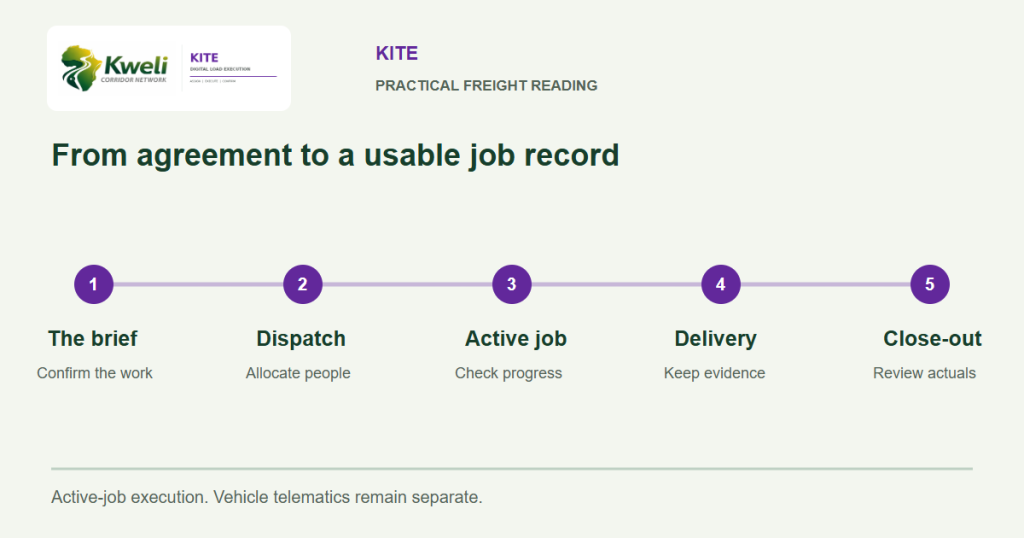
KITE supports planning, allocation of carriers, drivers and vehicles, and dispatch. Following active work helps the coordinator decide when to recheck the next commitment. It does not remove the need to confirm a changed collection with the customer or account for maintenance and safety constraints.
Agree who may change an allocation
In a small fleet, the owner and dispatcher can both believe they control the last truck. Choose a person to confirm new commitments and a way to record changes. When a delay threatens the next job, contact the affected parties early and agree a workable alternative rather than quietly switching equipment.
Practical questions
Can I treat an estimated delivery time as confirmed truck availability?
No. Check unloading, repositioning, vehicle readiness, driver arrangements and any remaining constraints before committing to the next collection.
What does KITE add to a small fleet’s planning?
KITE supports resource planning, vehicle and driver allocation, dispatch and active-job follow-through. The operator remains responsible for feasible commitments and changes agreed with customers.
Reviewed 7 November 2026. Examples are illustrative, not customer case studies. Product availability and current terms should be checked through official Kweli or Synesys guidance.