KITE practical reading · Owners, dispatchers and freight coordinators
When loading is delayed, record what is known, who must act and when the next update is due. Keep the agreed collection time separate from actual arrival and loading times. A useful delay record supports coordination; payment for waiting still depends on the parties’ agreement.
In an illustrative job, a truck arrives at 09:10 for a 09:00–10:00 collection window. At 10:20 the site says the cargo is not ready. “Driver waiting” is true, but gives the office little basis for a decision. Add the arrival reference, the site response, the expected loading time if one was given, and the delivery booking at risk.
Build an exception note that someone can act on
- Time and place: when the observation was made and which collection site it concerns.
- Confirmed fact: the truck has checked in; cargo release remains pending.
- Source: the named site contact or driver who supplied the information.
- Consequence: the delivery appointment or following allocation may need review.
- Next action: who is asking for a loading decision, and when the office will check again.
A forecast is different from an event. Write “site expects loading at 12:00” rather than recording loading as complete. If that forecast changes, keep the new information and its time instead of silently replacing the earlier account.
Agree changes before assuming they are approved
Ask the responsible customer contact about revised collection and delivery arrangements. If waiting charges, extra distance or overnight costs may arise, refer to the agreed terms and seek the relevant approval. A screenshot or location pin alone does not create an entitlement to payment.
Also review the truck’s next job. A vehicle still awaiting cargo cannot honestly be advertised as ready elsewhere at the original time. Update the availability you communicate through free LX or to an existing customer.
Use active-job visibility to support the conversation
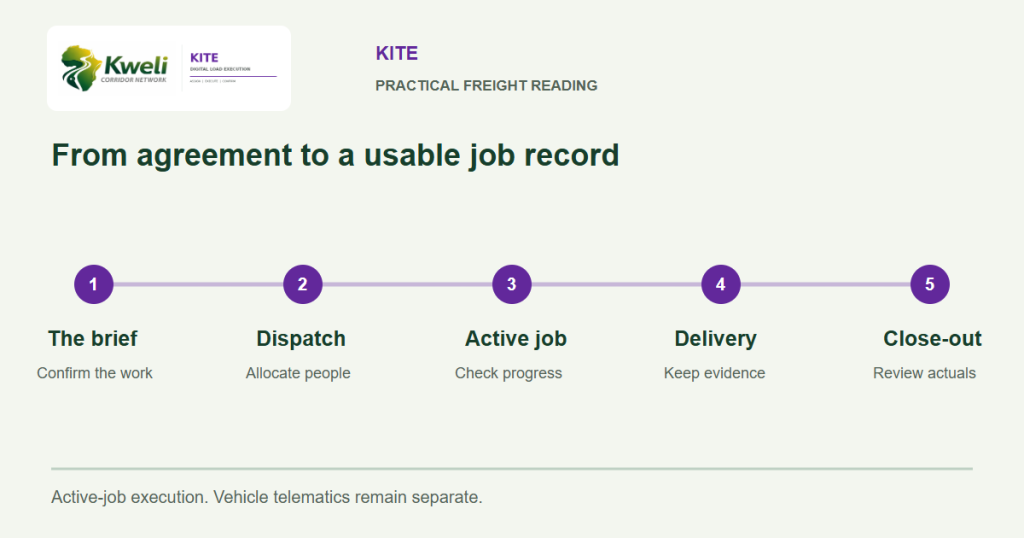
KITE connects dispatch, active-job progress and evidence with the movement. Read the freshness of the available information before making a promise. A carrier’s vehicle telematics is separate, and devices, networks and human updates can all leave gaps.
A useful customer message is: “The truck checked in at 09:10. The site advised at 10:20 that cargo release is pending. We have asked for a revised loading time and will update you at 11:00.” It communicates facts and ownership without inventing an arrival guarantee.
Close the delay record after delivery
Compare the agreed plan with arrival, loading, departure and delivery evidence. Keep explanations for material gaps. Review repeated problems with the customer before the next quote, using your own trip-cost assumptions rather than treating every waiting hour as free.
Practical questions
Does recording a delay guarantee waiting-time payment?
No. The applicable freight agreement and approvals determine whether waiting is chargeable. A clear record helps the parties assess what happened.
What should a delay update contain?
State the latest confirmed event, its time and source, the effect on the movement, who is acting and when the next update is due.
Reviewed 7 November 2026. Examples are illustrative, not customer case studies. Product availability and current terms should be checked through official Kweli or Synesys guidance.