KITE practical reading · Owners, dispatchers and freight coordinators
Before dispatch, turn the load agreement into one working brief that the operator, driver and customer can understand. Confirm the cargo, actual sites, collection window, suitable vehicle, named contacts and required delivery evidence. A successful application does not fill in missing operating instructions.
Consider an illustrative small operator who finds a Gauteng–Durban load on free Kweli LX. The price is agreed, but the collection message says only “warehouse, morning”. The driver cannot plan a gate arrival or identify the person releasing the cargo. The next useful action is to complete the brief.
Separate agreement from readiness
Keep the agreed commercial terms intact, then ask what must be true for the truck to move. Record unanswered questions as open tasks with a person responsible. Do not turn a proposed collection time into a confirmed booking simply because it appears on a dispatch sheet.
- Cargo: description, quantity, mass, dimensions and handling requirements supplied by the responsible party.
- Equipment: actual truck and trailer, suitable payload and loading arrangements.
- Sites: full collection and delivery instructions, access restrictions and appointment references.
- People: driver, dispatch contact, release contact and delivery contact.
- Exceptions: who authorises changes, waiting and extra work.
- Evidence: collection record, delivery documents and any customer-specific requirements.
Use a short readiness conversation
Ask the driver to explain the first stop and next action in their own words. This catches misunderstandings that a forwarded document may conceal. If the driver expects a forklift and the site expects side loading, resolve it before departure. Do this while safely parked; administration should never compete with driving.
A dispatcher can use three headings: confirmed, waiting for confirmation, and changed since agreement. For example: “Truck confirmed; delivery booking pending with customer; collection moved from 08:00 to 10:00 and acknowledged by driver.” That is more useful than a green status with no explanation.
Where KITE fits
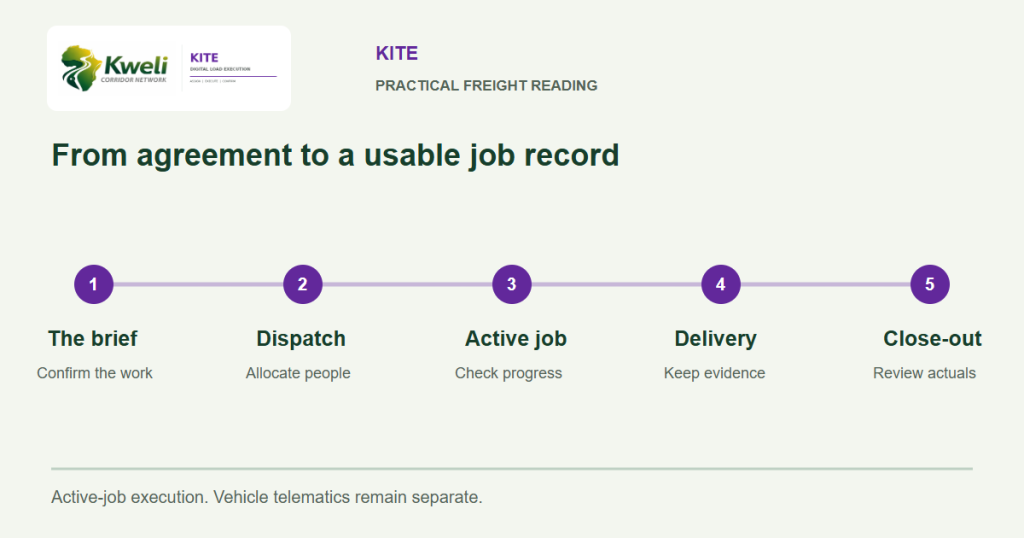
KITE supports resource planning, allocation and dispatch, followed by active-job progress, evidence and close-out. Its value is keeping the execution context together after the work is agreed. It does not make an unsuitable vehicle suitable or authorise a changed freight agreement.
Drivers participate through Hamba in a browser. KITE is an optional paid product with current price, usage and trial terms shown in the Hub. LX remains free to use independently.
Review the first handover before adding complexity
For the next few jobs, note which dispatch questions caused a second call. Add recurring omissions to your brief and remove fields nobody uses. The aim is a departure decision the people doing the work can trust, rather than a longer form.
Practical questions
Does winning a load mean the truck is ready to depart?
No. Confirm the operating brief, suitable equipment, people, timing and site requirements before departure. An agreement can still contain unanswered dispatch questions.
Do I have to buy KITE to use the free Load Exchange?
No. Kweli LX remains free on its own. KITE is an optional paid execution product with its current terms shown in the Hub.
Reviewed 7 November 2026. Examples are illustrative, not customer case studies. Product availability and current terms should be checked through official Kweli or Synesys guidance.